
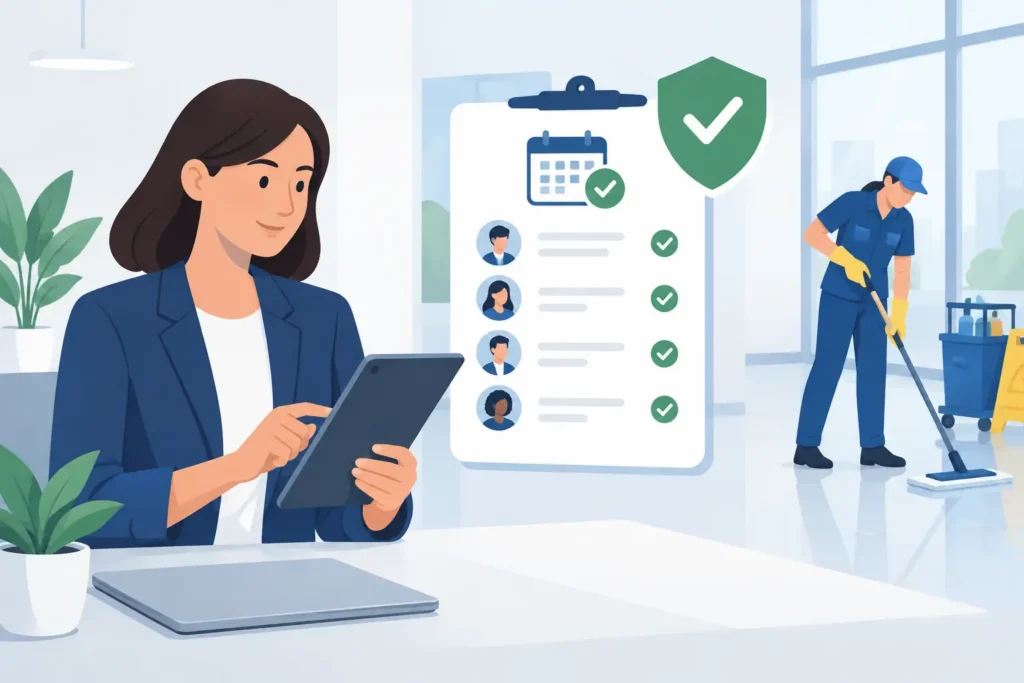
A cleaner who arrives late, misses a visit or leaves well before the scheduled finish can affect far more than the appearance of your premises. For a childcare centre, it can leave high-touch spaces below the expected hygiene standard. For an office, it can mean staff and visitors arrive to an untidy workplace. For an RTO, it can create an avoidable concern when students, trainers or auditors walk through the door. Knowing how to verify cleaner attendance gives facility managers confidence that scheduled work is being delivered as agreed.
Attendance should never be the only measure of a cleaning service. A team can be present without completing the required work to a proper standard. But reliable attendance records provide an essential starting point for accountability, quality checks and constructive conversations when something is not right.
Why cleaner attendance deserves attention
Commercial cleaning is often completed outside normal business hours, when a manager may not be on site to see the team arrive or leave. That arrangement is practical and keeps disruption low, but it also relies on trust and clear systems.
A dependable contractor should make that trust easy to maintain. If there is uncertainty about whether a visit occurred, how long the cleaner was on site or who attended, it becomes difficult to investigate concerns fairly. It can also make it harder to respond after an incident, manage site access or demonstrate that your cleaning programme is being monitored.
For childcare and education settings, the stakes are particularly clear. These environments have regular cleaning needs, vulnerable users and high expectations from families and regulators. Offices and professional workplaces also depend on consistent service, especially where client-facing areas, shared kitchens and amenities shape daily impressions.
The aim is not to monitor cleaners unnecessarily. It is to have a sensible, agreed way to confirm that the right people attended at the right time and that the service supports your operational needs.
Ways to verify cleaner attendance
The most suitable method depends on your site, operating hours and level of security. A small office with a familiar evening cleaner may need a simpler process than a multi-room childcare centre or an RTO with varied classroom schedules. The best approach is clear, proportionate and easy to review.
Technology-tracked check-in and check-out
A location-based or site-specific check-in and check-out system provides a time-stamped record of each visit. It can show when a cleaner arrived and departed, creating a consistent attendance trail without requiring a manager to be present.
This approach is useful because records are available when questions arise. If a site contact notices an issue the next morning, they can confirm whether the scheduled visit was completed before assuming what happened. It also supports risk management by recording who accessed the premises and when.
Technology is most useful when it is used properly. Confirm that the provider can explain what the records show, who can access them and how exceptions are handled. A missed check-in can happen because of a flat mobile battery or a connection issue. It should be investigated, not treated automatically as proof that a cleaner did not attend.
Site access records
Many commercial sites use keys, swipe cards, fobs, alarm systems or access-control logs. These can offer a second source of confirmation, particularly for after-hours cleaning.
Access records alone are not a complete picture. A card swipe may show that someone entered a building, but not which areas were cleaned or whether the full scope was completed. Still, when reviewed alongside attendance records and periodic inspections, they can help identify a pattern or clarify an isolated concern.
Keep access arrangements controlled and current. If a cleaner leaves a provider or a roster changes, cards, codes and key registers should be updated promptly. This is good security practice as well as good contract management.
Cleaning reports and task completion records
For sites with detailed requirements, a shift report or digital task checklist can add useful context. It may record duties completed, additional requests, consumables noticed as low and any maintenance issues found during the visit.
A checklist is not a substitute for an inspection. It is a record of the cleaner’s work and observations, rather than independent evidence that every task met the required standard. Its value comes from using it alongside regular quality checks and open communication.
This is especially helpful where cleaning duties change from day to day. An RTO may need extra attention in a training room after a practical session. A childcare centre may have a spill response or an event that changes the usual routine. Clear reporting helps both parties understand what was completed and what needs follow-up.
Supervisor checks and occasional site visits
A supervisor visit, whether scheduled or occasional, provides a more direct view of attendance, presentation and work quality. It can also give cleaners practical support, particularly at complex sites or where the scope has recently changed.
There is a balance to strike. Constant unannounced scrutiny can undermine a respectful working relationship, while no oversight at all leaves too much to assumption. Periodic checks, carried out professionally and documented clearly, are generally more useful than trying to watch every shift.
Attendance is not the same as cleaning quality
It is possible to confirm that a cleaner attended and still find that the service fell short. A reliable cleaning arrangement needs both attendance accountability and outcome-based quality control.
Set standards around the result you expect: hygienic bathrooms, emptied rubbish bins, clean floors, orderly entry areas and properly maintained high-touch surfaces. The details will vary by site. Childcare facilities need particular focus on safe, thorough cleaning of child-accessible spaces. Office clients may place greater emphasis on kitchens, meeting rooms and reception areas. RTOs may need classrooms, amenities and student-facing spaces consistently ready for use.
Fixed-price, end-result billing supports this focus. Rather than treating time on site as the product, it keeps attention on whether the agreed work has been completed to the required standard. Attendance records still matter, but they sit within a broader commitment to dependable results.
Set expectations before the service begins
The easiest attendance issue to manage is the one that has been prevented through a clear agreement. During the site inspection and quote process, discuss cleaning windows, access arrangements, site restrictions and the process for reporting changes.
Be specific about what happens if a cleaner is delayed, unable to attend or needs to reschedule because of an emergency. A professional provider should advise the relevant contact promptly and arrange suitable cover where possible. For a centre opening early, an office hosting visitors or an RTO preparing for an audit, advance notice gives you options.
It is also worth agreeing on who receives attendance information and how often. Some clients only need records available on request. Others prefer a monthly report or notification of exceptions. Neither choice is universally better. The appropriate level of reporting depends on the size of the site, security requirements and your internal processes.
Respond to a suspected missed visit fairly
If you believe a cleaning visit was missed or shortened, start with the facts. Check the attendance record, access information and any cleaning report. Take note of the specific areas that were not up to standard and the date or time you observed them.
Then contact the cleaning provider promptly. A clear, practical message is more effective than a vague complaint: explain what you found, when it was identified and whether immediate rectification is required. This gives the provider a fair opportunity to check their own records, speak with the assigned team and respond quickly.
Avoid drawing a conclusion from one sign alone. An untidy room may have been used after the cleaner left, a digital check-in may have failed, or an additional duty may have taken time away from a lower-priority task. Equally, repeated gaps in records or recurring quality concerns should not be ignored. Patterns call for a documented discussion and a plan to improve performance.
Questions to ask your cleaning provider
Before appointing a contractor, ask how they record arrivals and departures, how missed check-ins are managed and whether records can be provided if needed. Ask who attends your site, what training and screening applies, and how relief staff are introduced when regular cleaners are unavailable.
For childcare and education sites, ask about police checks and Working With Children Checks. For all sites, ask how the provider manages keys, alarms and access codes. These questions are not administrative extras. They help establish whether the contractor understands the responsibility that comes with working in your premises.
Newcastle Cleaning Co. uses technology-tracked check-in and check-out at each site, supporting clear attendance records alongside trained staff, quality standards and flexible scheduling. For clients, that means a practical way to maintain confidence without adding another daily task to an already busy workload.
A well-run cleaning service should feel dependable in the background: the team attends as scheduled, the premises are ready for use, and clear records are available when you need them. That is the kind of accountability that lets you focus on running your centre, workplace or training organisation.