
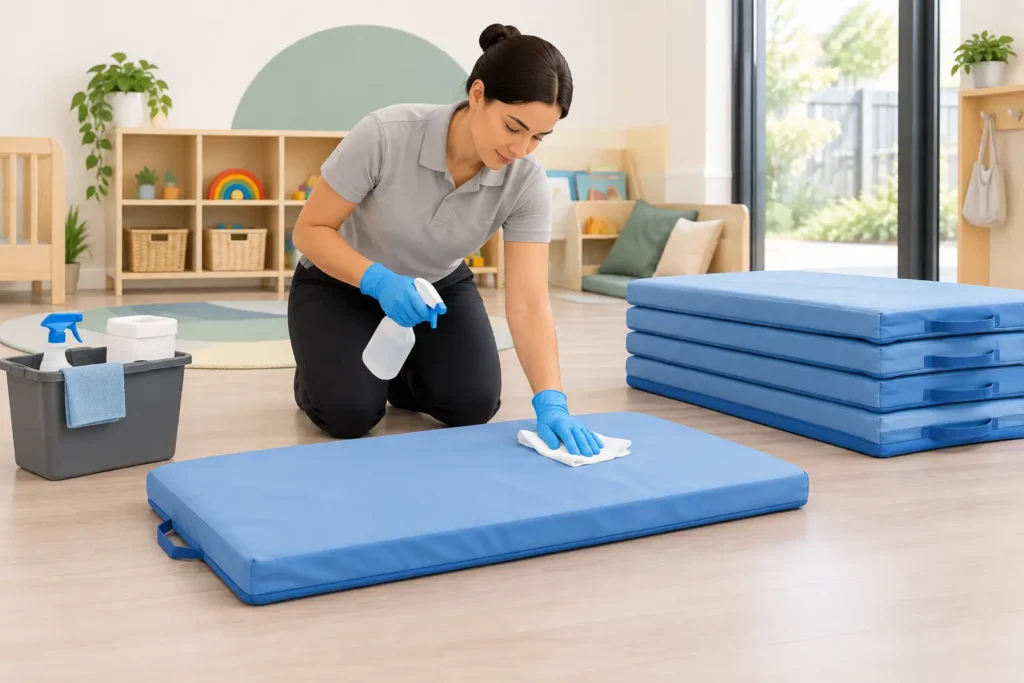
A nap mat can look tidy at pack-up time and still be unsuitable for the next rest period. It may have food crumbs in the seams, moisture held in the foam, or a cover returned before it is fully dry. To clean childcare nap mats safely, centres need a routine that considers the mat material, the product being used, drying time and clear separation between each child’s belongings.
For busy early learning centres and OOSH services, this is not simply another cleaning task. Rest equipment is in close contact with children and is used repeatedly through the week. A practical, documented process helps support the centre’s hygiene arrangements under the National Quality Framework, particularly National Quality Standard Quality Area 2, Children’s health and safety, and Quality Area 3, Physical environment. It does not guarantee compliance, but it gives staff and approved providers a clear, workable standard to maintain.
Start with the mat, not the cleaning product
Nap mats are not all made to be cleaned in the same way. Some have a removable fabric cover and waterproof inner, while others are one-piece vinyl, foam-filled mats or foldable sleeping mats with stitched joins. The manufacturer’s care instructions should set the starting point, especially where laundering temperatures, bleach use or machine drying are concerned.
Using a strong product because it seems more thorough can damage waterproof coatings, make vinyl brittle, fade fabric or leave residue behind. It can also create a practical problem if the mat has not had sufficient time to air and dry before children use it again.
Before introducing a new routine, identify which mats are in use and record the appropriate care method for each type. This is especially useful where a centre has accumulated several brands over time, or where an OOSH service brings portable rest equipment in and out of shared rooms.
Keep each child’s rest items separate
A named nap mat, fitted sheet, blanket and comfort item should stay allocated to one child wherever the service’s policy and the item design allow. Labels need to remain legible after laundering, so use a method that does not compromise the fabric or create a rough surface.
Avoid stacking damp mats directly together. Moisture caught between folded mats can lead to odours and deterioration, particularly during humid Newcastle summers. Store clean, dry mats off the floor in a clean cupboard or designated rack, away from nappy-change areas, food preparation spaces and cleaning chemical storage.
A practical routine to clean childcare nap mats safely
The right frequency depends on your centre policy, the manufacturer’s instructions, how the mat is used and whether there has been soiling. A sound routine usually combines daily checks with scheduled laundering or surface cleaning, rather than relying on a once-in-a-while deep clean.
At the end of each rest period, staff can shake out loose debris away from children and food areas, check mats for wetness, stains or damage, and set aside any item that needs attention. Sheets and removable fabric covers should be managed according to the centre’s laundering procedure. Where a child’s mat is visibly soiled, it should be removed from use promptly and handled with gloves where appropriate.
For wipe-clean surfaces, first remove visible soil using the approved cleaning method. Cleaning and disinfection are different steps. A disinfectant is less effective over dirt or residue, so applying it to an unclean mat is not a substitute for proper cleaning. If a disinfectant is required under the service’s infection control procedure, use only a product suitable for that material, follow its label directions and allow the stated contact time.
After cleaning, the mat must be left to dry fully. Do not fold it wet, cover it with linen or return it to storage while moisture remains in seams and folds. Good ventilation matters here. In coastal suburbs such as Merewether, Charlestown and Belmont, humid conditions can extend drying times, while sand and grit brought in from outdoor play can quickly collect around mat edges.
Use chemicals carefully around children’s equipment
A childcare centre should have an approved product list, current safety data sheets and clear instructions for dilution, application and storage. Staff and contracted cleaners need to work from the same instructions. A product that is suitable for hard floors may not be suitable for a child’s rest mat, particularly a porous fabric cover or coated foam surface.
Never mix cleaning products. Keep chemicals in their original labelled containers or a correctly labelled decanted container, stored securely away from children. Use the protective equipment specified by the product instructions and ensure rooms are ventilated while cleaning takes place.
Fragrance is not proof of cleanliness. Strongly scented products may be unpleasant in a sleep room and can mask a damp-mat issue that still needs to be resolved. Choose products based on their suitability for the material and the centre’s procedures, not on smell alone.
Where cleaners attend after hours, the scope of works should state exactly what is expected. For example, it may cover cleaning and drying of wipeable mats supplied by the centre, while educators retain responsibility for child-specific linen and items requiring laundering. Clear boundaries prevent assumptions at the end of a long day.
Build a routine staff can actually maintain
The most reliable systems are simple enough to follow on a busy afternoon. Assign responsibility for rest equipment, identify where used and clean mats are placed, and keep a short record of scheduled cleaning. A daily visual check does not need to become paperwork for its own sake, but it should make it easy to spot recurring concerns such as leaking drink bottles, worn covers or a storage cupboard that is not staying dry.
A useful procedure should cover these points:
- how individual mats and linen are labelled and separated;
- what happens after visible soiling, vomiting, toileting incidents or suspected contamination;
- which products and methods are approved for each mat type;
- where mats dry and how they are stored once dry; and
- who checks that after-hours tasks have been completed.
For a multi-site provider, consistency matters as much as the written procedure. One centre may have drying racks and commercial laundry access, while another uses portable mats in a shared hall. The underlying standard can be the same, but the practical steps may need to change by site.
Plan for spills, outbreaks and worn equipment
A normal scheduled clean is not the answer to every incident. When a mat is contaminated with body fluids, isolate it from other equipment and follow the service’s incident and infection control procedures. Staff should know who to notify, what personal protective equipment is needed and whether the mat can be cleaned according to its instructions or needs to be removed from use.
During periods of increased illness, centres may need to review their cleaning frequency and processes in line with public health advice and their own policies. This is also a good time to check supplies, laundry capacity and staff handover arrangements. The goal is not to create an elaborate process, but to avoid rushed decisions when several children are away and the team is under pressure.
Inspect mats regularly for split seams, exposed foam, cracked waterproof layers and covers that no longer fasten securely. A damaged mat is harder to clean effectively and may no longer be suitable for use. Replacement is sometimes the safer and more practical option than repeated patching.
Make after-hours cleaning accountable
After-hours commercial cleaning can support a centre’s daytime team by addressing floors, bathrooms, touchpoints, rubbish and agreed sleep-room tasks without disrupting children’s routines. But rest mats need specific instructions rather than a vague request to “clean the sleep room”. The contractor should know whether mats are to be wiped, where they are placed to dry and which items must not be moved or mixed.
For Newcastle and Lake Macquarie centres, school holiday and Christmas shutdown periods are a sensible opportunity to inspect storage, clean underneath mat racks and review the condition of sleep-room flooring. Sand from parks and beaches, dust in window tracks and summer humidity can all affect how clean and dry the space remains.
A dependable contractor should provide evidence that scheduled cleaning occurred, while the centre retains oversight of child-specific routines. Newcastle Cleaning Co, for example, uses technology-verified check-in and check-out for agreed after-hours cleaning visits, giving site managers a record that the visit took place.
A well-kept nap mat should not rely on guesswork. When the care method is clear, products are suitable, drying is complete and responsibilities are documented, staff can prepare the room for rest time with greater confidence and children have a clean, comfortable place to settle.