
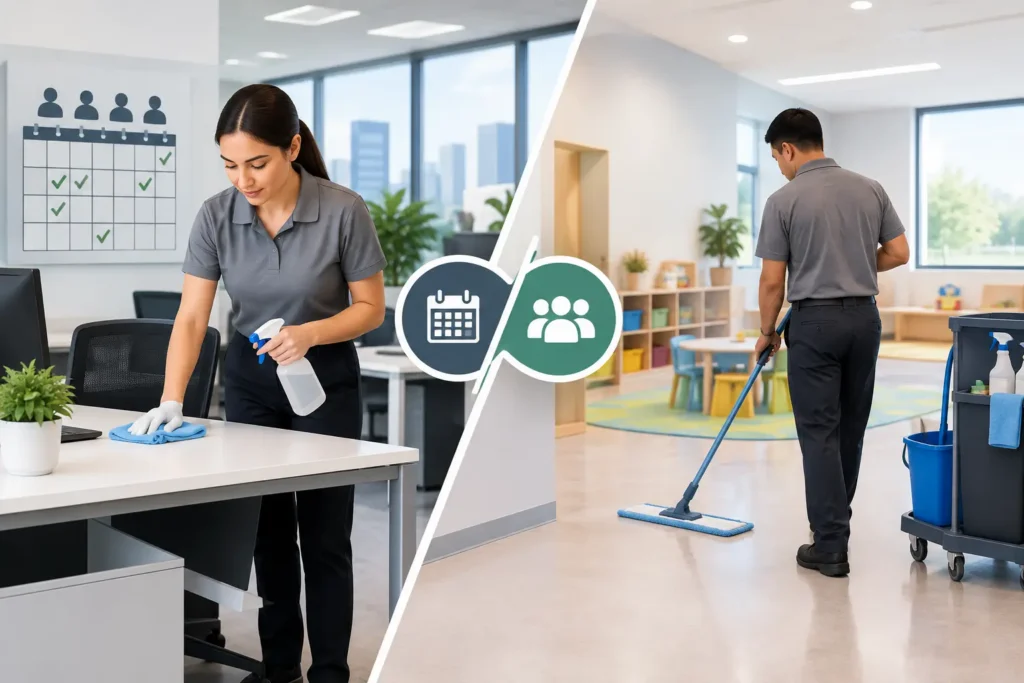
A cleaning roster can look straightforward on paper: assign tasks, nominate staff and review the checklist at the end of the day. The difficulty is keeping that plan working when people are absent, the site is busy or cleaning competes with the many other jobs your team must do. When weighing cleaning rosters versus contracted services, the useful question is not simply who holds the mop. It is who is accountable for a consistently clean, safe and presentable workplace.
For childcare centres, RTOs, offices and strata common areas, the right answer depends on the premises, operating hours and the level of oversight required. A well-managed internal roster can suit limited daily duties. A contracted after-hours service can remove a recurring operational burden, particularly where standards must be consistent across several rooms, amenities or sites.
What an internal cleaning roster really involves
An internal roster allocates cleaning duties to employees, educators, administration staff, caretakers or a dedicated in-house cleaner. It often covers immediate tasks such as wiping tables, managing spills, emptying rubbish and resetting shared spaces during operating hours.
These duties are necessary. In an early learning centre, educators need to respond to spills, toileting accidents and activity mess as they occur. In a training facility, staff may need to reset a room between sessions. An office team may manage kitchen benches and meeting-room tidiness through the day. These are operational tasks, and they cannot always wait until after hours.
The challenge begins when the roster is also expected to deliver the full evening clean. Toilets, floors, touchpoints, kitchen areas, bins, entryways and detailed dusting can become rushed or deferred when the nominated person is covering leave, supervising children, assisting a student, dealing with visitors or finishing their core work.
A roster also needs active management. Someone must train staff in the expected standard, supply consumables, check completion, follow up missed items and arrange cover during absences. If those responsibilities are unclear, a checklist may exist without providing much assurance that the work was completed properly.
Where internal rosters work well
Internal rosters are often useful for light, immediate and visible work. They give staff ownership of the spaces they use and help keep a site orderly between professional cleaning visits.
For example, an OOSH service may roster quick room resets after afternoon activities, while the contracted cleaner handles floors, amenities and rubbish after the service closes. A Newcastle CBD office might ask staff to clear their desks and wash personal cups, while its after-hours cleaner takes care of shared areas. This division is practical because it separates day-to-day habits from the work that needs dedicated time and equipment.
A roster may also be suitable for a very small workplace with few rooms, low foot traffic and a staff member whose role genuinely includes cleaning. The important point is to be realistic about the time required. If the work needs to happen after the building is empty, or it is regularly postponed, the roster may no longer be the most reliable arrangement.
Cleaning rosters versus contracted services: the practical difference
Contracted cleaning shifts responsibility for the agreed scope of works to a cleaning provider. Following an on-site inspection, the provider documents what will be cleaned, how often it will be cleaned and any site-specific duties. The business or centre still manages its premises, but it does not need to organise the evening cleaning roster each week.
For busy decision-makers, accountability is usually the deciding factor. With a contract service, there should be a clear point of contact, a written scope, scheduled visits and a process for raising concerns. At Newcastle Cleaning Co, cleaners check in and out at each visit using an on-site tag or QR code, providing a record that the scheduled clean took place.
That does not mean a contractor can replace sensible on-site routines. Staff still need to report maintenance issues, store items appropriately and deal with immediate mess during the day. The strongest arrangement is commonly a combination: staff manage the immediate environment, while an after-hours cleaning team completes the detailed recurring work.
Consider the demands of your type of site
Early learning centres and OOSH services
For early learning settings, cleaning supports the daily expectations around children’s health and safety and the physical environment. The National Quality Framework and National Quality Standard, particularly Quality Area 2 and Quality Area 3, provide a useful lens for assessing whether routines, facilities and environments are appropriately maintained. Cleaning alone does not guarantee compliance or an assessment outcome, but a dependable cleaning program supports the systems a centre has in place.
A centre director also needs confidence in who enters the premises after hours. For childcare and education sites, confirm that cleaners have a current Working With Children Check (WWCC) and police check, and that access, alarms and keys are managed carefully. The NSW Office of the Children’s Guardian and ACECQA expectations make sound site processes especially relevant.
Internal teams should continue immediate cleaning and room resets. A contracted service can then take responsibility for the end-of-day clean across classrooms, bathrooms, staff areas, kitchens, offices and entry points. During humid Newcastle summers, or after wet weather brings sand and grit in from parks and beaches, this dedicated time can be particularly valuable.
RTOs and training facilities
Training rooms can look clean at the start of a week and deteriorate quickly after back-to-back classes, practical sessions and student breaks. A clear cleaning arrangement helps maintain orderly classrooms, amenities, reception areas and shared kitchens without asking trainers or administration staff to stay back.
For RTOs, a clean and well-maintained environment supports the broader operational systems considered under ASQA and the Standards for RTOs. It is not a substitute for compliance work, but it reduces one avoidable source of complaints and distractions before an audit or site visit.
Where an RTO runs evening courses, a cleaning schedule may need to work around changing timetables. One site may need five evening visits a week; another may only need two. The scope should reflect actual room use rather than a generic package.
Offices, workplaces and strata common areas
In professional offices, a missed clean often shows up first in kitchens, amenities, bins and reception. In a strata building, it is usually the foyer, lifts, corridors and shared amenities that shape occupants’ and visitors’ impressions. These spaces benefit from a set standard and a clear method for reporting issues.
Coastal salt air can leave windows and entry glass looking marked sooner in suburbs such as Merewether, Charlestown and Warners Bay. Periodic window cleaning, carpet steam cleaning or pressure washing may be appropriate additions to a regular contract, rather than jobs left until the premises look noticeably neglected.
For workplaces, cleaning also sits alongside WHS obligations. SafeWork NSW guidance places responsibility on businesses to provide and maintain a work environment without risks to health and safety, so far as reasonably practicable. Good cleaning supports this through clear walkways, maintained amenities and prompt attention to spills, while maintenance hazards still need their own reporting and repair process.
Questions to ask before deciding
Before retaining an internal roster or appointing a contractor, test the arrangement against normal disruptions rather than its best week. Ask whether cleaning is completed when staff are absent, whether anyone verifies the result, and whether complaints are resolved without repeated reminders.
It also helps to ask four practical questions:
- Are core staff spending time on cleaning that should be spent with children, students, clients or their primary work?
- Is there written proof of what was cleaned, when it was cleaned and who completed it?
- Does the scope cover periodic needs such as school holiday deep cleans, Christmas shutdown cleans, carpets or windows?
- Can the arrangement adapt if rooms are added, operating hours change or a site relocates?
If the answers rely on goodwill and last-minute workarounds, a contracted service may provide greater certainty. If the site is genuinely small and the work is consistently completed and checked, an internal roster may remain appropriate.
Set up either option properly
Whether cleaning is done in-house or contracted out, vague expectations lead to variable results. Walk through the premises and identify each area, its frequency and the result expected. “Clean amenities” is open to interpretation. A stronger instruction specifies toilets, basins, mirrors, floors, bins, consumables and any site-specific requirements.
Review the arrangement at least each term, season or major operational change. A childcare centre may need a deeper clean in school holiday periods. An office may need extra attention after a fit-out or move. Christmas closure periods are often the right time to organise work that is difficult to complete during normal operations.
The best choice is the one that leaves your team free to do their own work, while giving you confidence that the premises will be ready for the next day. A documented scope, realistic schedule and clear evidence of completed cleaning turn an everyday task into a dependable part of running the site.