
A cleaner saying they attended is no longer enough for many site managers. Commercial cleaning technology trends are moving towards simple, usable proof: confirmation that a visit occurred, clarity around what was completed, and a quick way to raise an issue before it becomes a complaint from staff, parents or visitors.
For childcare centres, RTOs, offices and strata common areas, the useful technology is rarely the flashiest. It is the technology that supports a dependable after-hours routine without adding work for the people responsible for the site. A QR check-in, a practical site checklist and prompt communication can be more valuable than an expensive machine that does not suit the building.
Commercial cleaning technology trends worth watching
The strongest trend is accountability at each service visit. Site-based check-in and check-out systems, often using a QR code or on-site tag, create a time-stamped record that a cleaner attended. This is particularly useful where a manager is not on site after hours, or where an approved provider, area manager or strata committee needs confidence that agreed work has been completed.
Attendance records are not a substitute for inspecting quality. A cleaner can be on site without every task being completed to the required standard. But they do provide a reliable starting point when a question arises about a missed visit, an access issue or a concern raised the following morning.
For a multi-site early learning provider, this can make oversight far simpler. For an RTO operating evening training rooms, it can help confirm cleaning has taken place between classes. In an office at Newcastle CBD or Hamilton, it can give an office manager a clear record without needing to stay back to meet the cleaning team.
Digital checklists are becoming more site-specific
Generic cleaning lists have limited value. A better approach is a digital or documented checklist built around the actual scope of works for the premises.
A childcare centre may need close attention to entry areas, bathrooms, nappy change areas, sleep rooms, kitchen-adjacent surfaces and outdoor-access points. An RTO may need classrooms reset, training equipment areas kept tidy, amenities serviced and high-use touchpoints attended to. An office might prioritise kitchens, meeting rooms, workstations, reception and shared amenities. A strata foyer has a different rhythm again, particularly where wet-weather foot traffic affects floors and entry glass.
Technology makes it easier to keep those instructions current when a room changes use, a fit-out is completed or an extra duty is added. The benefit is consistency, not paperwork for its own sake. A clear scope of works gives cleaners practical direction and gives the client a fair basis for checking outcomes.
Faster issue reporting is more useful than more reporting
Mobile communication tools allow cleaners to report a problem while they are at the site: a leaking tap, an empty consumable dispenser, a damaged bin, a spill needing specialist attention or an area they could not access. For the client, a short, relevant message is preferable to discovering the issue days later.
The trade-off is that communication needs boundaries. Decision-makers do not need a stream of routine notifications each night. Agreeing what should be reported immediately, what belongs in a weekly update and what is simply dealt with within the normal clean keeps the process useful.
A typical example is an after-hours cleaner finding that a classroom is locked before an early morning course. Recording the access issue promptly means the RTO can address it, rather than assuming a missed task was a cleaning failure. Good technology supports that conversation with facts.
Equipment is changing, but suitability still comes first
Battery-powered commercial equipment is increasingly practical for smaller and medium-sized sites. Quieter vacuums and cordless tools can reduce disruption in buildings with late staff, evening classes or residents near common areas. They can also make it easier to work efficiently in spaces with limited power points.
However, battery equipment needs charging routines, maintenance and enough capacity for the site. It is not automatically the right choice for every building. A reliable cleaning contractor will select equipment based on floor types, access, operating hours and the agreed scope, rather than treating new equipment as a selling point on its own.
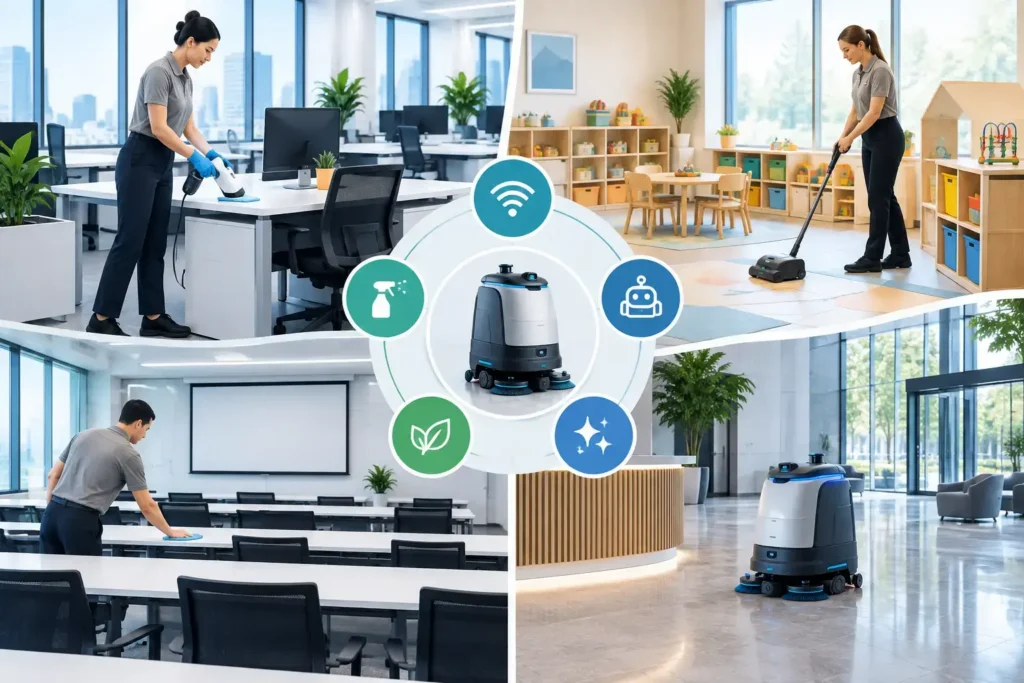
Autonomous floor machines attract attention, but they are not a natural fit for every commercial site. They can be useful in large, open and predictable spaces. Most local childcare centres, training facilities and professional offices have furniture, corners, stairs, mixed floor finishes and changing layouts that still require a person who notices detail. Technology can support skilled cleaners, but it does not remove the need for them.
Sensors and dispensers can help, if someone owns the follow-up
Smart dispensers and occupancy-based amenity monitoring can indicate when supplies are low or a high-use bathroom needs attention. In a busy office or shared strata amenity, that information can assist planning.
For scheduled after-hours cleaning, though, the basics remain central: the service frequency must match the number of people using the site, and the cleaner needs clear authority to replenish agreed consumables. Data without a defined response process can create another alert for an already busy manager to manage.
What technology means for childcare and education sites
Cleaning technology should support the safe operation of a centre or training environment, not make broad compliance promises. For early learning services, well-managed cleaning routines contribute to the practical expectations behind the National Quality Framework and National Quality Standard, particularly Quality Area 2, Children’s health and safety, and Quality Area 3, Physical environment.
Records of attendance, clear cleaning schedules and documented issue reporting can help a centre demonstrate organised processes when preparing for an ACECQA-related assessment and rating visit. They do not guarantee an outcome. The same principle applies to policies, supervision, maintenance and every other part of running an education and care service.
Childcare and OOSH services should also consider who has access to digital systems and site information. Cleaning teams working in these settings need the appropriate police checks and Working With Children Check (WWCC) arrangements. Technology records should be handled sensibly, with access limited to the people who need them.
For RTOs, cleaning documentation may support the orderly presentation and upkeep of training rooms, amenities and common areas. It can sit alongside the broader systems an RTO maintains under ASQA and the Standards for RTOs. A clean, prepared facility helps learners and trainers start the day properly, but it is only one component of a well-run training operation.
Local conditions still shape the cleaning plan
Technology does not change the fact that Newcastle and Lake Macquarie sites deal with local conditions. Coastal salt air can leave windows and entry glass looking dull sooner than expected, especially around Merewether, Caves Beach and other exposed areas. Sand and grit tracked in from beaches, parks and car parks can mark hard floors and collect at entrances.
Humid summers can increase the need for careful attention to amenities, bins and ventilation-adjacent areas. School holiday and Christmas shutdown periods are also a sensible time to plan deeper tasks such as carpet steam cleaning, window cleaning or a detailed clean of rooms that are normally occupied every day.
The best technology assists with planning these periodic services. It should not encourage a one-size-fits-all schedule. A centre with active outdoor play areas has different needs from a Cardiff office or a Charlestown training facility with mostly indoor foot traffic.
Questions to ask before choosing a technology-enabled cleaner
Before focusing on an app or dashboard, ask practical questions. How is attendance verified at each visit? Can the system reflect our actual scope of works? Who sees the records, and how are issues escalated? What happens if a cleaner cannot gain access or finds a maintenance concern? How often will we receive updates, and who is responsible for quality checks?
Also ask whether the contractor can explain the limits of its system. Honest answers matter. A QR scan verifies presence, not every cleaning outcome. Photos may be useful for particular issues, but they need to be appropriate for the environment and privacy requirements. Automated equipment may improve efficiency in the right location, but it cannot replace judgement in a busy, varied site.
Newcastle Cleaning Co has used technology-verified check-in and check-out as a practical record of each scheduled clean. Combined with a written fixed-price scope of works and local supervision, that kind of simple accountability gives busy decision-makers something more useful than vague assurances.
Choose technology that makes cleaning easier to verify, issues easier to resolve and expectations easier to maintain. The right system should fade into the background while your centre, training facility or workplace opens each day clean, prepared and ready to use.