
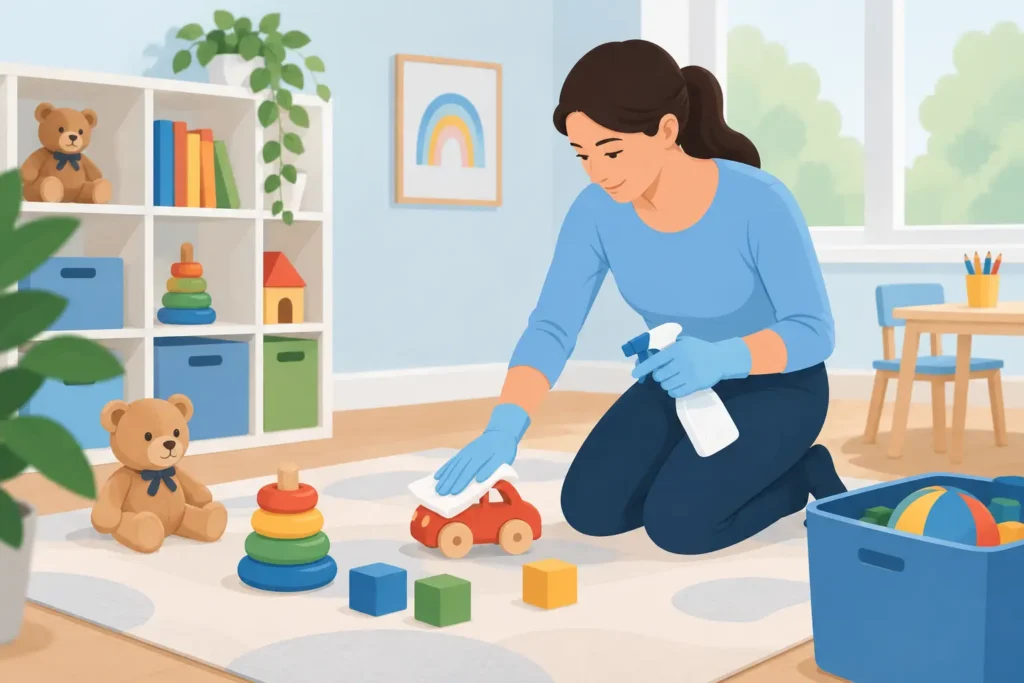
A playroom can look tidy after a busy morning and still need careful attention. Toys move between small hands, tables become craft stations and snack areas, and floors quickly collect more than is visible. Knowing how to sanitise playrooms properly helps childcare centres protect children, support educators and maintain the confidence of families.
For centre directors and managers, the goal is not to create a harsh, chemical-heavy environment. It is to establish a reliable cleaning routine that removes soil first, uses appropriate products correctly and fits around the rhythm of the day. The best approach is practical, consistent and easy for staff to follow.
Start by separating cleaning, sanitising and disinfecting
These terms are often used interchangeably, but they serve different purposes. Cleaning removes visible dirt, food residue, dust and organic matter from a surface. It is the essential first step because a sanitiser cannot work effectively through grime.
Sanitising reduces germs on a cleaned surface to a safer level. In a playroom, this is usually the regular approach for shared tables, frequently handled toys and other child-accessible items. Disinfecting is a stronger process intended to kill a broader range of germs, and may be required after illness incidents or where your infection-control procedures direct it.
The right level of treatment depends on the surface, how children use it and what is happening in the centre. A routine clean and sanitise may suit a table after morning tea. A vomiting, diarrhoea or blood incident requires immediate isolation of the area and a response in line with your centre’s infection-control procedures and product directions.
Build your playroom routine around the day
A dependable routine is more effective than a major clean done only when the room begins to look untidy. Break the work into clear daily tasks, between-use tasks and incident-response tasks, with responsibilities that are realistic for educators and cleaning staff.
Before children arrive, check that floors are free of debris, rubbish bins are emptied, handwashing areas are clean and supplies are available. At transitions during the day, focus on eating surfaces, high-touch points and toys that have been mouthed or shared heavily. At close, complete the deeper clean so the room is ready for the next session without disrupting learning or care.
For busy centres, a simple written schedule helps prevent uncertainty. It should identify what is cleaned, how often, which product is used and who checks completion. This is especially useful across multiple rooms, relief staff arrangements or extended-hour operations.
Prioritise high-touch and high-risk surfaces
Not every surface needs the same treatment at the same time. Start with the places children and educators touch most often: tables, chair backs, door handles, cupboard pulls, light switches, taps, toilet flush buttons and nappy-change areas. Pay close attention to shared equipment such as keyboards, tablets, headphones and sign-in devices where educators or visitors use them.
Food and drink areas deserve their own routine. Clean and sanitise tables before and after meals, then allow the product to remain on the surface for the stated contact time before wiping or air-drying as directed. Do not rush this step. Spraying a product on and immediately wiping it away may not deliver the intended result.
Nappy-change surfaces should be cleaned and sanitised between children, with fresh paper or protective coverings used where applicable. Keep cleaning products and equipment out of children’s reach at all times, and avoid storing them beside food, bottles or play resources.
How to sanitise playrooms without damaging toys
Toys need a system, not a once-a-week sweep. Children naturally explore with their hands and mouths, so frequently used play resources require regular cleaning. If a toy has been mouthed, sneezed on, used by an unwell child or dropped in a toileting area, remove it from circulation straight away and place it in a designated container for cleaning.
Hard plastic toys are generally straightforward to clean. Remove visible dirt with detergent and water, rinse where needed, then sanitise using a product suitable for the material and follow its label directions. Allow items to dry fully before returning them to children. Small toys can be rotated through labelled tubs, which makes it easier to separate clean items from those awaiting attention.
Soft toys, dress-ups, cushions and fabric resources need a different approach. Check care labels and wash on an appropriate cycle, ensuring items are completely dry before use. If an item cannot be effectively cleaned after a contamination incident, it may need to be removed from the room. Damaged toys with cracks, peeling coatings or hard-to-clean crevices should also be reviewed, as they can hold dirt and moisture.
Wooden toys require care because excessive soaking can cause swelling or cracking. Use only the amount of moisture needed, select products compatible with the finish and dry them promptly. The same caution applies to books, puzzles and electronic toys. Wiping high-touch areas may be appropriate, but saturation can ruin materials and create unnecessary replacement costs.
Choose products for safety and correct use
A product is only suitable when it is fit for the surface, used at the correct dilution and given enough contact time. Read the label and Safety Data Sheet before introducing any chemical to a playroom. Staff should know how to dilute concentrates, what personal protective equipment is required, where products can be used and what to do if a spill occurs.
Avoid mixing cleaning chemicals. Combining products can create fumes or reduce effectiveness. Use clearly labelled spray bottles only, never food or drink containers, and keep chemicals in a locked storage area.
Fragrance is not a measure of cleanliness. In childcare settings, heavily scented products can be unpleasant for children and staff, particularly those with sensitivities. A low-odour product that is suitable for the task and used as directed is often the more practical choice.
Microfibre cloths and mop heads should be changed regularly rather than carried from one area to another. Colour coding can help prevent cross-contamination – for example, using separate equipment for bathrooms, food areas and general play spaces. Launder reusable cloths and mop heads after use according to your hygiene procedure, and allow them to dry properly.
Do not overlook floors, air and shared equipment
Floors may not seem like a high-touch surface, but children spend considerable time playing on them. Vacuum or sweep to remove loose debris, then mop using a method appropriate for the flooring. Treat spills immediately, especially food, body fluids, paint and water, both for hygiene and slip prevention.
Ventilation also supports a healthier indoor environment. Where practical, open windows or use the building’s ventilation system as intended, particularly after cleaning or when rooms have been occupied for long periods. Good airflow does not replace surface hygiene, but it is part of a well-managed playroom.
Shared sensory resources deserve special planning. Water-play tubs, playdough tools, sand equipment and communal art supplies can quickly become contamination points if left unmanaged. Set clear rules for emptying, cleaning and drying equipment between sessions or at the end of each day. Where an activity cannot be cleaned effectively, consider whether it should be single-use, individually allocated or rotated.
Keep records that support consistency
Cleaning records should be useful, not paperwork for its own sake. A short checklist can demonstrate that routine tasks were completed, flag issues requiring follow-up and give managers visibility over standards across rooms. Record additional cleaning after illness incidents, maintenance concerns and any products or equipment that need replacing.
Quality checks matter as much as the checklist itself. A supervisor should periodically inspect the details that are easy to miss: under furniture, behind doors, inside toy tubs, on skirting boards and around taps. These checks help identify whether the routine needs adjustment rather than simply assuming it is working.
For centres using an external cleaning provider, agree on clear boundaries. Educators may manage immediate between-use sanitising, while trained cleaning staff complete scheduled end-of-day work, floors, bathrooms and detailed high-touch cleaning. Newcastle Cleaning Co. works with facilities to tailor duties and schedules around how each site operates, so hygiene standards are maintained without interrupting care.
A well-sanitised playroom should not feel clinical or difficult to manage. It should feel ready: clean toys available for play, tables prepared for the next activity and staff confident that the routine protects the children in their care. When the process is clear and consistently checked, hygiene becomes a dependable part of the day rather than a last-minute task.