
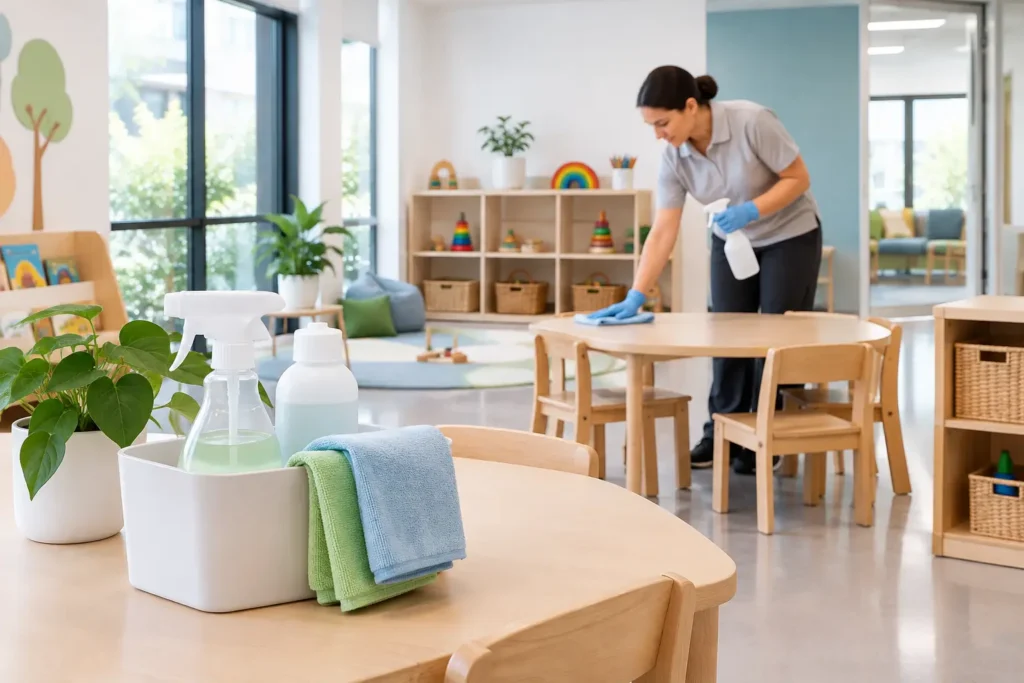
A spray bottle left on a low shelf, a decanted chemical without a label, or a strong product used in a poorly ventilated bathroom can quickly become a concern in an early learning setting. This child safe cleaning products guide is designed for centre directors, nominated supervisors and OOSH coordinators who need practical controls that work during busy daily operations and after-hours cleaning.
The aim is not to remove every cleaning chemical from a childcare centre. Floors, bathrooms, nappy change areas, kitchens and high-touch surfaces all need regular, suitable cleaning. The priority is choosing fit-for-purpose products, controlling how they are used and making sure they are inaccessible to children.
Start with the task, not the product claim
A product described as “natural”, “green” or “gentle” is not automatically suitable for an early learning environment. Likewise, a stronger chemical is not automatically the better choice. The right product depends on the surface, the soil being removed, the instructions on the label and who may be exposed to it.
For routine cleaning, a centre may need a general-purpose cleaner for washable surfaces, a bathroom cleaner suited to toilets and basins, a floor cleaner matched to the floor finish, and a product approved for the specific hygiene task required. Avoid building a cupboard full of overlapping products simply because each one makes a broad marketing claim.
Ask practical questions before adding a product to the cleaning scope of works. Is it needed for a defined task? Can it be used safely in the available ventilation? Does it leave residue that needs rinsing? Is the dilution clear? Can the container be securely stored? A simple, smaller product range is easier for staff and contractors to use consistently.
For centres in Newcastle, Lake Macquarie and coastal suburbs such as Merewether, Belmont and Caves Beach, sand and grit can be an everyday issue. The first answer is often more frequent dry soil removal at entrances, not a harsher floor chemical. Good mats, regular vacuuming or sweeping, and suitable damp mopping protect floors while reducing the amount of product needed.
What child-safe cleaning looks like in practice
Child-safe cleaning is a system, rather than a label on a bottle. It includes product selection, secure storage, trained handling, correct dilution, clear records and timing cleaning work so children are not nearby.
Store chemicals as though a child will find them
Cleaning products should remain in their original labelled containers wherever possible and be kept in a locked, dedicated cupboard or storeroom. The storage area should not double as a place for children’s bags, art supplies or food. Access needs to be controlled even when a room is being reset at the end of the day.
If a product must be transferred to a smaller bottle for use, the new container needs a durable label that identifies the product and its handling requirements. Unlabelled spray bottles create avoidable risk and confusion, particularly where several educators, relief staff and cleaners share a site.
Check storage arrangements during room changes, renovations and holiday programs. A cupboard that was secure when a preschool room was set up may become accessible after furniture is moved. OOSH programs can also bring older children into spaces that are usually staff-only, so access controls should be reviewed rather than assumed.
Use the label and safety information properly
The product label and Safety Data Sheet set out the manufacturer’s directions for use, dilution, personal protective equipment, first aid and storage. These documents should be available to the people using the product, not buried in an old email folder.
More concentrate does not mean a better clean. Over-diluting can leave slippery or irritating residue, damage surfaces and create unnecessary chemical exposure. Under-diluting may mean the product does not perform as intended. Measuring equipment, clearly marked bottles and straightforward instructions reduce guesswork.
Never mix cleaning products unless the manufacturer specifically directs it. Combining products can produce hazardous fumes or reactions. This is especially relevant in enclosed bathrooms, cleaners’ rooms and small amenities where ventilation may be limited.
Clean after hours where the task permits
Scheduled after-hours cleaning provides a useful layer of control. It allows cleaners to complete bathrooms, floors and other detailed work without children moving through the area, while giving surfaces time to dry before the next session.
That does not remove the need for daytime cleaning. Spills, toileting accidents and food preparation areas may need immediate attention. In those situations, staff need a simple response procedure: restrict access to the area, use the appropriate product and equipment, allow the surface to dry as directed, then return the space to use.
A reliable contractor should work around the centre’s operating pattern, including early starts, late pickups and holiday programs. At Newcastle Cleaning Co, after-hours scopes are agreed following an on-site inspection, so product use and cleaning tasks can be matched to each centre’s rooms, storage and schedule.
A practical child safe cleaning products checklist
Reviewing the cleaning cupboard once each term can prevent small gaps from becoming recurring problems. For each product, confirm the following:
- it has a clear purpose within the centre’s cleaning routine;
- the label is intact and the container is in good condition;
- the Safety Data Sheet is current and easy for staff to locate;
- staff and cleaners know the required dilution and handling instructions;
- it is stored securely, away from food, children’s materials and personal belongings;
- expired, damaged or unidentified products have been removed through an appropriate disposal process; and
- cleaning tools, such as mop heads and cloths, are cleaned, dried and stored to avoid cross-contamination between areas.
For multi-site providers, keep the product list and core storage standard consistent across centres where possible. Individual sites may need variations for flooring, kitchens or outdoor amenities, but a common baseline makes training, audits and supply ordering easier to manage.
Support the National Quality Standard without overcomplicating it
Cleaning arrangements form part of the broader environment children, families and educators experience every day. They can support the intent of the National Quality Framework and National Quality Standard, particularly Quality Area 2 – Children’s health and safety – and Quality Area 3 – Physical environment.
This does not mean a cleaning contractor can guarantee compliance, an assessment outcome or a rating. Centre leadership remains responsible for its own policies, risk controls and daily practice. However, a documented cleaning scope, safe chemical storage, clear product instructions and reliable completion records provide useful operational evidence that cleaning has been planned and managed.
ACECQA guidance and centre policies should guide early learning services. In NSW, approved providers should also consider their responsibilities through the NSW Office of the Children’s Guardian and their own child-safe practices. A contractor attending after hours should have appropriate access arrangements, police checks and, for childcare and education sites, a current Working With Children Check (WWCC).
The same approach can be adapted for training facilities. RTOs have different learners and operating patterns, but classrooms, shared amenities and kitchens still need sensible chemical controls. A clear cleaning program can support a well-maintained learning environment alongside an RTO’s obligations under the Standards for RTOs and general WHS duties.
Include cleaners in your site safety routine
A strong cleaning plan can fail when the people doing the work have not been given the practical information they need. Before a contract starts, walk through the site with the contractor and identify the chemical cupboard, water points, waste areas, ventilation issues, alarm procedures and rooms that need special handling.
Be clear about who supplies products and who approves substitutions. This matters when a familiar item is unavailable or a new floor finish is installed after a refurbishment. A quick product swap without checking suitability can lead to damaged surfaces, unpleasant odours or a cleaning routine staff do not understand.
Reliable attendance also matters. If cleaning is scheduled after hours, a check-in and check-out record gives the centre a straightforward way to confirm each visit occurred. It is not a substitute for quality checks, but it helps management follow up promptly when a concern is raised.
Humid Hunter summers are another reason to keep routines consistent. Moisture around bathrooms, entryways and poorly ventilated rooms should be addressed through regular cleaning, drying and reporting of maintenance concerns such as leaks or failing exhaust fans. Cleaning staff can report what they see, while the centre arranges the required building maintenance.
Plan ahead for shutdown periods
School holiday and Christmas shutdown periods are useful opportunities to review the cleaning cupboard, remove surplus supplies and schedule work that is difficult to complete during normal operations. Carpet steam cleaning, detailed window cleaning and deeper floor care may be appropriate depending on the site and its surfaces.
Coastal salt air can leave windows and glass looking dull sooner than expected, particularly around Newcastle and Lake Macquarie. Regular window cleaning can improve presentation, but the product and method should be suited to the glass, frames and nearby play areas. Planning these tasks during closures reduces disruption and allows time for drying and inspection.
A calm, workable chemical routine gives educators one less operational concern to carry. Keep the product range purposeful, lock it away, train the people who use it and review the process whenever the site or program changes. That is the practical foundation for a cleaner, safer early learning environment.