
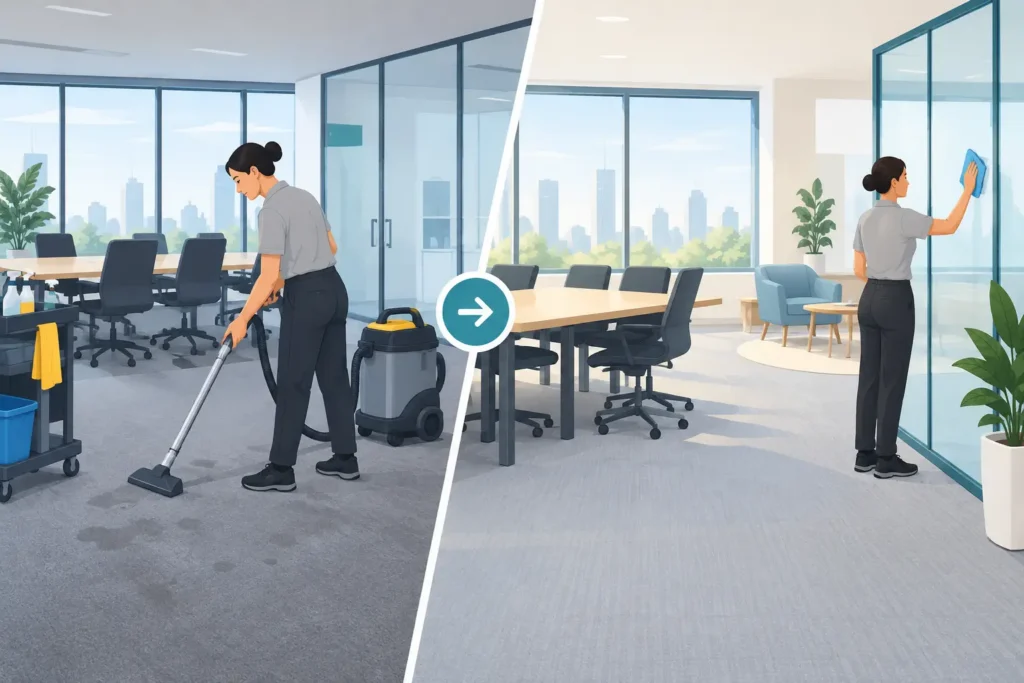
A cleaning contract rarely fails all at once. More often, it starts with a missed bin, then an amenity that is not properly restocked, then a parent, student or staff member asking why the same issue keeps returning. This cleaning changeover case study sets out what a well-managed transition should look like when a commercial site needs a more dependable after-hours cleaning arrangement.
The scenario below is a typical example rather than an account of a particular client. It reflects the concerns regularly raised by childcare centres, RTOs, offices and strata common areas across Newcastle, Lake Macquarie and the lower Hunter.
The situation: confidence had slipped
A medium-sized workplace had an existing cleaning arrangement, but the standard had become inconsistent. Staff arriving in the morning found rubbish left behind, touchpoints overlooked and consumables running low. There was no simple record confirming whether the cleaner had attended on a given evening, so every concern turned into a time-consuming exchange of messages.
The site manager did not need a more complicated cleaning program. They needed the agreed work completed consistently, after hours and without disruption to the people using the building.
This is a common point of change for commercial sites. For an early learning centre, concerns may be raised by educators or families about the presentation of bathrooms, entry areas or shared spaces. For an RTO, it may be a looming ASQA audit or a training room that does not look ready for the next group. In an office, it may be visitors noticing neglected amenities or staff losing confidence that issues will be addressed.
A cleaning provider cannot guarantee a National Quality Standard assessment outcome, an ASQA audit outcome or compliance with WHS obligations. However, a documented, dependable cleaning process can support the daily conditions that matter to Quality Area 2, Children’s health and safety, and Quality Area 3, Physical environment, under the National Quality Framework.
Cleaning changeover case study: starting with the real scope
The first useful step was an on-site inspection. A changeover based on a quick phone estimate creates room for assumptions, particularly where a site has several entry points, different floor surfaces or areas used only on certain days.
During an inspection, the practical questions are straightforward. Which rooms are used each evening? What must be ready before staff arrive? Which amenities receive the heaviest use? Where are cleaning supplies, bins and keys kept? Are there access restrictions, alarm procedures or areas that require particular care?
At this site, the scope of works separated routine duties from periodic work. Regular after-hours cleaning covered the areas used each day: floors, bathrooms, kitchen or staff facilities, rubbish removal, wipe-downs and presentation of shared spaces. Less frequent requirements, such as internal windows, carpet steam cleaning or a shutdown deep clean, were agreed separately.
That distinction matters. If a task is expected but never written into the scope, it can easily become a source of disappointment. Equally, a cleaning contractor should not add unexpected costs for work that has not been approved. A written, fixed-price scope gives both sides a practical reference point.
Site details change the work
A generic checklist is not enough. Coastal windows in Merewether, Newcastle CBD or Caves Beach can show salt air residue quickly. Sand and grit tracked in from parks, footpaths and car parks can make entry areas look neglected soon after cleaning. In humid summers, bathrooms and kitchen areas may need closer attention to presentation and ventilation issues.
For childcare centres and OOSH services, a scope should reflect the rooms children use, the timing of collection and set-up, and secure access arrangements. Cleaners working in these environments should hold a current Working With Children Check (WWCC) and police check, with procedures that respect the site’s child-safe requirements and direction from the NSW Office of the Children’s Guardian.
For RTOs, the scope may need to account for classrooms, break-out spaces, training rooms and amenities used at different times across the week. For offices and strata common areas, first impressions often centre on foyers, lifts, corridors and shared bathrooms. The right priority depends on how the building operates, not on a one-size-fits-all schedule.
Planning the handover before the first clean
Changing cleaners can feel disruptive, especially for a centre director or office manager already juggling staff, visitors and day-to-day issues. A good handover reduces that burden by agreeing the basics before the first service begins.
The site manager and contractor should confirm access, alarm and lock-up arrangements, contact details for urgent questions, storage locations and any building-specific safety requirements. This is also the point to identify fragile finishes, areas that are out of bounds, rubbish collection arrangements and site hazards relevant to SafeWork NSW and the site’s own WHS procedures.
In the typical scenario, the incoming team completed an initial detailed clean. This was not presented as a cure for every longstanding issue. It was a practical baseline, intended to bring neglected areas back to the agreed presentation standard before routine cleaning commenced.
The trade-off is worth recognising. A first clean may take more attention than an ordinary nightly visit, particularly where buildup has been left in amenities, kitchen areas or edges of flooring. Being clear about this at the outset prevents the first week from becoming an argument about what is routine and what is recovery work.
Proof of attendance changes the conversation
The site manager’s biggest frustration was not simply the cleaning itself. It was the uncertainty. When a concern arose, they had no clear way to establish whether a scheduled visit had occurred.
For the new arrangement, each visit was recorded through technology-verified check-in and check-out using an on-site tag or QR code. This does not replace quality supervision, nor does it prove every individual task was completed perfectly. What it does provide is a clear record that the cleaner attended the site at the scheduled time.
That record is particularly useful for multi-site early learning providers, busy training facilities and workplaces where the person managing the contract is not present after hours. It gives the decision-maker a factual starting point when following up an issue, rather than relying on guesswork.
Quality checks need to be practical
The first few weeks of a changeover are when communication matters most. The site manager should be able to raise a concern quickly, and the contractor should be able to respond without turning every small adjustment into a formal dispute.
In this typical example, the review focused on a handful of practical checks: were the bathrooms consistently presentable, were rubbish and recycling handled as agreed, were entry areas clean for the morning, were consumables being monitored, and had any access issues emerged? These checks were specific enough to act on and short enough for a busy manager to manage.
Not every request should automatically become part of the ongoing scope. A one-off spill, event set-up or additional room may call for an agreed extra service. The value of a good contract is that routine responsibilities are clear, while genuine changes can be discussed openly.
What the site gained from a structured changeover
The most useful outcome was not a dramatic transformation. It was predictability. The site manager had a written scope, an agreed schedule and a record of attendance. Staff had a clearer standard for what to report, while the cleaning team had clear instructions about what mattered at the site.
For an early learning centre, this supports a clean, orderly environment for children, families and educators. For an RTO, it helps maintain training spaces that are ready for learners and visitors. For offices, workplaces and strata common areas, it helps protect the daily experience of staff, clients and tenants.
The same approach is useful before a school holiday closure or Christmas shutdown. Those quieter periods are often the right time to schedule a deeper clean, window cleaning, carpet steam cleaning or pressure washing, then begin the next term or working year with routine cleaning on a known baseline.
Questions to ask before changing cleaning contractors
A changeover is less risky when the discussion stays practical. Ask whether the contractor will inspect the site before quoting, provide a written scope of works and explain what is included in the fixed price. Confirm who will clean the site, how attendance is recorded, how concerns are reported and whether the team has the required checks for childcare and education settings.
Also ask how the contractor manages access, alarms and changes to the schedule. A provider that works after hours should make the process easier for your team, not require constant chasing.
Newcastle Cleaning Co has worked with local commercial sites since 1962, with scheduled cleaning arrangements built around the way each site operates. The right changeover does not need to be disruptive. It needs a clear scope, reliable people and enough visibility for you to know the work has been done.