
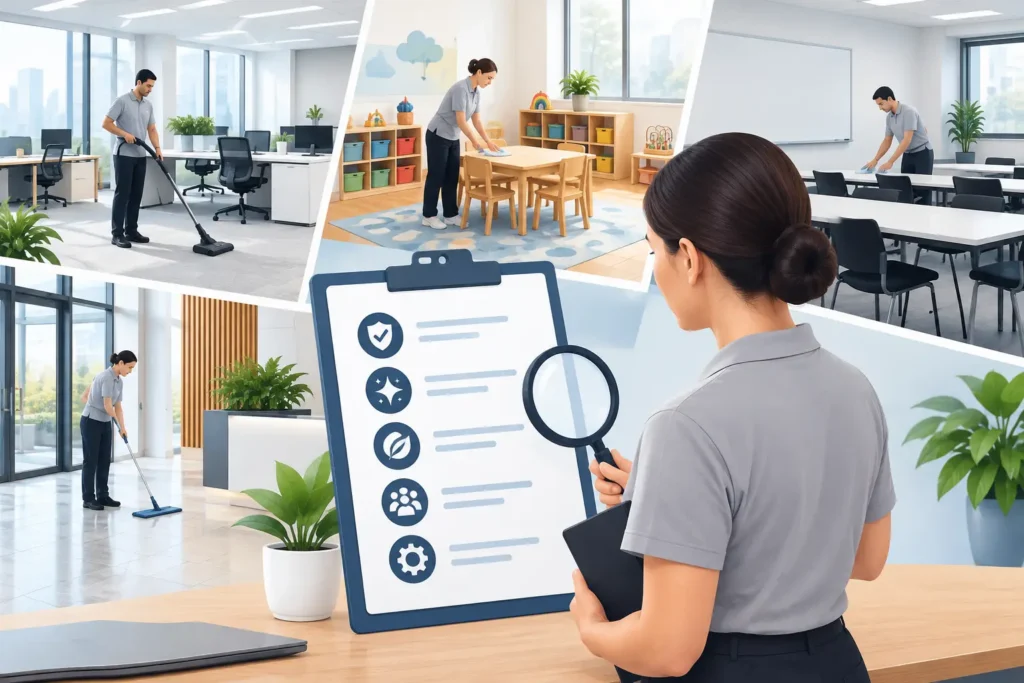
A missed clean is rarely just an untidy bathroom or a full rubbish bin. It can mean a centre director fielding parent concerns, an RTO preparing for an audit with rooms not presentation-ready, or an office manager arriving early to deal with problems before staff and visitors arrive. Clear cleaning contractor review criteria help you assess whether a provider can do the work consistently, communicate properly and give you confidence after hours.
For childcare centres, training facilities, offices and strata common areas, the best decision is usually not based on a polished proposal alone. It comes from checking how a contractor will manage your particular site, prove each visit happened and respond when conditions change.
Start with an on-site inspection and clear scope of works
A contractor should inspect the premises before providing a fixed quote. This is where the practical details emerge: the number and type of amenities, floor surfaces, kitchen or staff-room use, rubbish arrangements, access points, security procedures and the times the building is empty.
Ask to see a written scope of works that separates routine duties from periodic work. Routine cleaning may cover floors, amenities, touchpoints, bins, kitchen areas and entry spaces. Periodic tasks can include carpet steam cleaning, windows, pressure washing or closure-period deep cleans. The document should say what is cleaned, how often, and any areas that are excluded or subject to separate agreement.
Vague descriptions such as “general clean” leave too much open to interpretation. A useful scope makes it easier for your team to check outcomes and raise an issue before it becomes a recurring frustration.
For a childcare centre, the scope should reflect the different needs of playrooms, sleep areas, staff facilities, entry areas and outdoor-adjacent spaces. For an RTO, it may include classrooms, reception, workshops where appropriate, break-out areas and student amenities. In an office or strata building, foyer presentation, shared kitchens and high-use bathrooms often need particular attention.
Cleaning contractor review criteria for reliable delivery
Once the scope is clear, look beyond the task list. The following criteria show whether a contractor has a workable system for delivering it.
Proof that each clean occurred
After-hours cleaning is largely unseen. That makes verification especially valuable. Ask how the contractor records arrival and departure at every visit, and whether the record is tied to the site rather than based on a manual timesheet.
Technology-verified check-in and check-out, such as an on-site tag or QR code, provides a straightforward record that a cleaner attended. It does not replace quality checks, but it answers a basic and important question: did the scheduled visit happen?
This matters when a missed visit is reported, when several people manage a site, or when an area manager oversees a small portfolio of centres or offices. It also gives both parties a factual starting point if there is a concern.
Staff suitability and site access
Review who may enter your building and what screening applies. At a minimum, ask about police checks, induction procedures, supervision and how access keys, fobs, alarm codes or swipe cards are managed.
Childcare centres and education providers should confirm that cleaners working on site hold a current Working With Children Check (WWCC) where required. This supports a centre’s wider safeguarding arrangements and expectations under the National Quality Framework. Cleaning also contributes to the day-to-day environment considered under the National Quality Standard, particularly Quality Area 2, Children’s health and safety, and Quality Area 3, Physical environment. It does not, on its own, guarantee compliance or an assessment outcome.
For RTOs, the same care with access, documentation and presentation can support orderly operations under the Standards for RTOs. A contractor should understand that a training facility may have changing class schedules, equipment rooms and periods when visitors are on site.
Quality checks and a named point of contact
A cleaning contract needs an easy path for reporting issues. Find out who you contact, how quickly concerns are acknowledged and what happens after an issue is raised. A local contractor with a clear point of contact is often easier to deal with than a distant call centre when an access arrangement changes or an urgent clean is needed.
Ask how quality is checked. Some sites need scheduled inspections; others work well with regular contact and spot checks. The right arrangement depends on the size of the premises, the complexity of the scope and how visible the cleaning result is to parents, students, staff or visitors.
It is reasonable to ask how repeat issues are handled. A good answer should cover investigation, correction and follow-up, rather than simply promising that the cleaner will be reminded.
Scheduling that fits how your site operates
The cleaning schedule should suit your operations, not force staff to work around a contractor. Most commercial sites need after hours cleaning, commonly five nights a week, though two or three visits may be appropriate for smaller offices or lower-use common areas.
Consider peak periods as part of the review. Newcastle and Lake Macquarie sites can contend with sand and grit tracked in from beaches, parks and wet weather, while humid summers can increase the attention needed in busy amenities. Coastal salt air can also leave windows and external glass looking tired sooner than expected.
Ask how additional work is arranged during school holidays, Christmas shutdowns, relocations or after a fit-out. These jobs should be clearly agreed rather than assumed to be included in routine visits.
WHS practices that work in a live business environment
Cleaning staff often work alone or when few people are on site. Your review should include practical WHS arrangements: chemical storage and labelling, safe handling of equipment, wet-floor controls, incident reporting and procedures for working around building security.
A contractor should be able to explain how its work supports your obligations under SafeWork NSW requirements and your own workplace procedures. For strata common areas, this includes considering residents and visitors who may enter a foyer or corridor while floors are drying. For education settings, it may include securing products and equipment outside operating hours.
The goal is not a folder of generic policies. It is evidence that the contractor has considered the risks at your site.
Test the proposal against real scenarios
Before appointing a contractor, use a few likely situations to test the service model. Ask what happens if a cleaner cannot attend, an alarm does not disarm, a bin room is unexpectedly overflowing, or a parent, staff member or tenant reports a missed area the next morning.
You are listening for specific, calm answers. Who is contacted? Is there a backup arrangement? How is attendance confirmed? When can the issue be rectified? A provider that understands these questions will generally make contract management easier once the service starts.
For multi-site childcare or education providers, ask whether each location can have its own scope and access notes while still providing consistent reporting. For office managers in Hamilton, Charlestown or Warners Bay, it may be more useful to establish who can approve occasional extra work when a meeting, event or building issue creates an unexpected need.
Review value through accountability, not assumptions
A fixed-price, outcome-based arrangement gives decision-makers a clearer basis for review than an open-ended hourly model. The focus should be on whether the agreed scope is delivered to the required standard, with agreed processes for additional duties.
That does not mean every site needs the same frequency or level of service. A compact professional office may need a different schedule from an active early learning centre, and a strata foyer may need more frequent attention to glass and entry floors than back-of-house areas. The right contractor will explain these trade-offs plainly and document the result.
When comparing proposals, make sure each contractor is pricing the same scope, schedule and periodic requirements. A lower-looking figure can reflect fewer visits, excluded areas or assumptions that only become obvious after the contract begins. Consistency in the brief makes comparison fairer and reduces surprises later.
Use the first months to confirm the decision
The review should continue after commencement. Set a simple early check-in point, usually after the first few weeks, to confirm access is working, the scope reflects actual use and communication is straightforward. Small adjustments early on are easier than allowing dissatisfaction to build.
Keep a short record of any issues and resolutions. This is particularly helpful when responsibilities are shared between a centre director, committee, facilities manager or area manager. Over time, the pattern matters more than a single imperfect night: attendance records, responsiveness, quality follow-up and whether the premises are reliably ready for the next day.
For organisations across Newcastle, Lake Macquarie and the lower Hunter, a dependable cleaning partner should make one part of the working week quieter. Choose review criteria that test the everyday reality of the service, and you will be better placed to appoint a contractor that stays accountable long after the proposal is signed.