
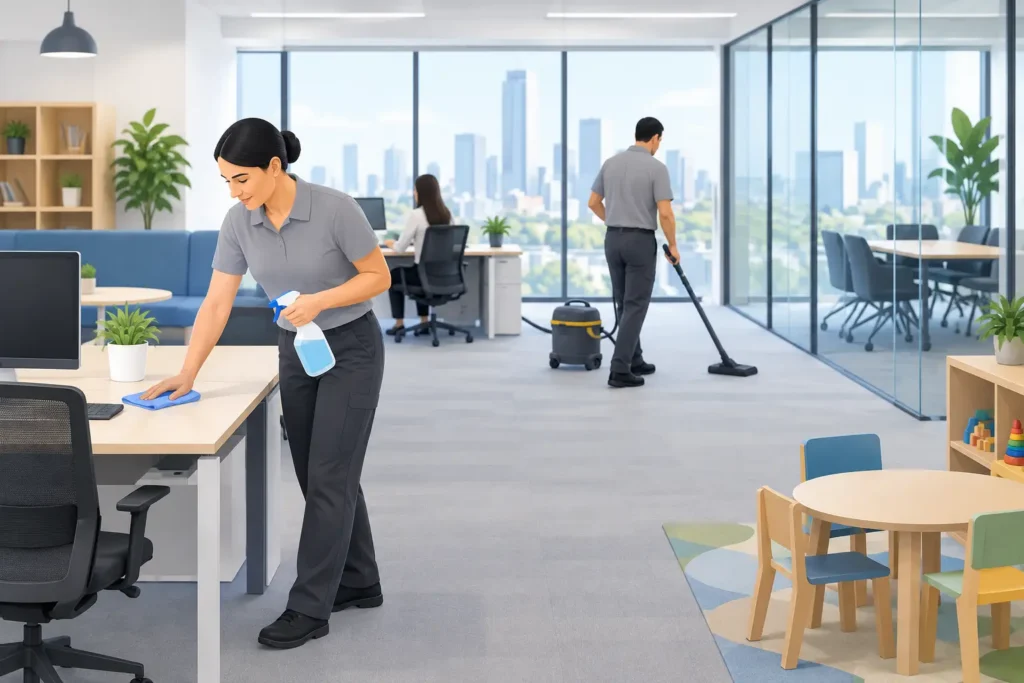
A cleaner arriving while staff are on calls, visitors are in reception or a meeting room is in use can turn a necessary service into an interruption. The most reliable way to reduce office cleaning disruption is to plan cleaning around how your workplace actually operates, rather than fitting it into a generic roster.
For offices in Newcastle, Lake Macquarie and the lower Hunter, that usually means a clear after-hours arrangement, sensible access procedures and a scope of works that reflects the spaces people use every day. It also means allowing for the local details that affect presentation: sand and grit carried in from beaches and parks, humid summer conditions in amenities, and coastal salt air settling on windows in suburbs closer to the coast.
Start with the hours that matter to your workplace
After-hours cleaning is often the simplest answer, but “after hours” should be specific. A professional services office may be quiet by 5.30 pm, while a training facility could have evening courses, and a community service provider may have late appointments or staff preparing for the following day.
Walk through the weekly rhythm of the site before setting a cleaning window. Consider regular meetings, late shifts, board nights, training sessions, deliveries and security lock-up times. If cleaning must occur while the workplace is occupied, agree on a reduced task list for those periods and schedule noisier or more intrusive work for later.
Vacuuming open-plan areas, cleaning bathrooms and mopping hard floors are usually best completed once staff have left. Wiping high-use touchpoints, removing rubbish from a kitchenette or tidying a foyer may be suitable during quieter periods, provided the cleaner can work safely and without blocking access.
The goal is not to make cleaners invisible. It is to make their work predictable, safe and timed so staff can focus on their own responsibilities.
Use a scope of works that matches the site
A vague instruction such as “clean the office” creates uncertainty for everyone. A written scope of works reduces disruption because it tells the cleaner what must be completed, where it is required and how often each task is expected.
For example, a five-night service might cover reception, workstations, meeting rooms, kitchenettes, amenities and rubbish removal each visit. Less frequently used stores, archive rooms or boardrooms may only need attention once or twice a week. Glass entry doors may need additional attention in a high-traffic office, while an office near Merewether or Caves Beach may require more regular internal and external window cleaning because of salt air and windblown grit.
A useful scope also identifies exclusions and site-specific requirements. This can include which bins are confidential waste, which offices are not to be entered, where cleaning supplies are stored, whether particular floors need low-moisture methods, and who approves extra work. Clear instructions prevent cleaners from having to interrupt staff to ask questions or make assumptions.
Review the scope after operational changes
Cleaning arrangements should change when the site changes. A fit-out may add glass partitions and meeting rooms. A new hybrid work pattern may reduce desk use but increase demand in shared collaboration areas. A move to a different floor, new tenant in a strata building or change in rubbish collection arrangements can all affect the service.
Review the scope after a significant change, and at planned intervals. A short site walk-through is often enough to identify whether tasks, frequencies or access arrangements need adjustment.
Make access easy without weakening security
Access problems are one of the most common causes of interrupted or missed cleaning. A cleaner who cannot enter a building, access a lift or disarm the relevant alarm zone may be unable to complete the agreed work. Asking staff to return after hours is disruptive and avoidable.
Agree on a practical access process from the beginning. That may involve keys held securely, an access card, a building fob, alarm instructions or a site contact for genuine emergencies. The process should also cover what happens if a door is unexpectedly locked, an area is occupied or a safety issue is found.
For workplaces handling sensitive information, cleaners should understand boundaries around paperwork, files and devices. Desks should be cleared as part of staff end-of-day routines, while cleaners should be instructed not to move documents, access locked offices without approval or interfere with IT equipment. This protects confidentiality and avoids the confusion that can follow a well-meant attempt to tidy a desk.
Reduce office cleaning disruption with practical zoning
Not every part of an office needs the same approach. Dividing the workplace into zones helps cleaners work efficiently and helps managers decide which areas can be serviced at different times.
Reception, amenities, kitchenettes and shared corridors generally need the most frequent attention because they affect daily presentation and hygiene. Meeting rooms may need a check after evening functions or early-morning bookings. Quiet offices, records rooms and staff-only areas can often be cleaned on a less frequent rotation if use is limited.
Zoning is particularly useful in strata common areas. A foyer, lift and shared amenities need to remain presentable without a cleaner obstructing tenants or visitors. Scheduling floor work outside peak arrival and departure periods makes a noticeable difference.
It also helps to plan periodic services separately. Carpet steam cleaning, window cleaning, pressure washing and deep cleaning are more intrusive than routine cleaning. They are often best scheduled during a Christmas closure, school holiday period or a planned low-occupancy weekend. Giving staff advance notice allows them to clear floors, secure belongings and avoid booking rooms that will be unavailable.
Set clear communication and escalation rules
Most cleaning issues become frustrating when nobody knows who should be told, or what will happen next. Give the cleaning provider one main contact and a backup contact, then agree on the best method for routine requests and urgent concerns.
A simple communication process might cover missed consumables, spills, damaged fittings, security concerns and requests for additional work. It should also state when the cleaner should contact the site manager immediately and when an item can be recorded for attention at the next visit.
For example, an overflowing bin in a reception area may need prompt action, while a request to clean internal glass in an unused meeting room can wait. The distinction keeps small matters from becoming disruptions while ensuring genuine issues are handled properly.
Reliable records matter too. Technology-verified check-in and check-out provides a straightforward record that a scheduled clean took place. This is useful for office managers who are not on site after hours and want confidence that the agreed service has been delivered.
Put safety ahead of convenience
Trying to squeeze cleaning around people can create WHS risks. Wet floors, trailing leads, cleaning equipment in walkways and work in occupied areas all need to be managed carefully. SafeWork NSW expectations apply to the workplace as a whole, so cleaners and site managers both benefit from clear procedures.
Arrange cleaning so floors can dry before staff arrive wherever possible. Identify areas where equipment cannot be left unattended, and ensure cleaners know emergency exits, building rules and any hazards unique to the site. In a workplace with evening staff, consider whether certain jobs should wait until the building is empty rather than being completed around them.
For training facilities, cleaning should also account for practical learning spaces, shared equipment and changing class timetables. Good cleaning supports a well-maintained environment relevant to ASQA expectations and the Standards for RTOs, but it does not replace the provider’s own systems, maintenance or compliance responsibilities.
Choose accountability over assumptions
A dependable cleaning arrangement should not rely on someone noticing a problem the following morning. Regular quality checks, a documented scope and proof of attendance make it easier to address concerns early.
Newcastle Cleaning Co has provided scheduled, after-hours commercial cleaning since 1962. Like any long-term cleaning partner, the value is in consistency: the cleaner understands the site, the manager knows what to expect, and changes are discussed before they affect daily operations.
If cleaning is disrupting your team, begin with a site walk-through and ask a practical question: what work needs to happen, and when can it be done without getting in the way? The answer will usually lead to a calmer workplace by morning, not another task for staff to manage.