
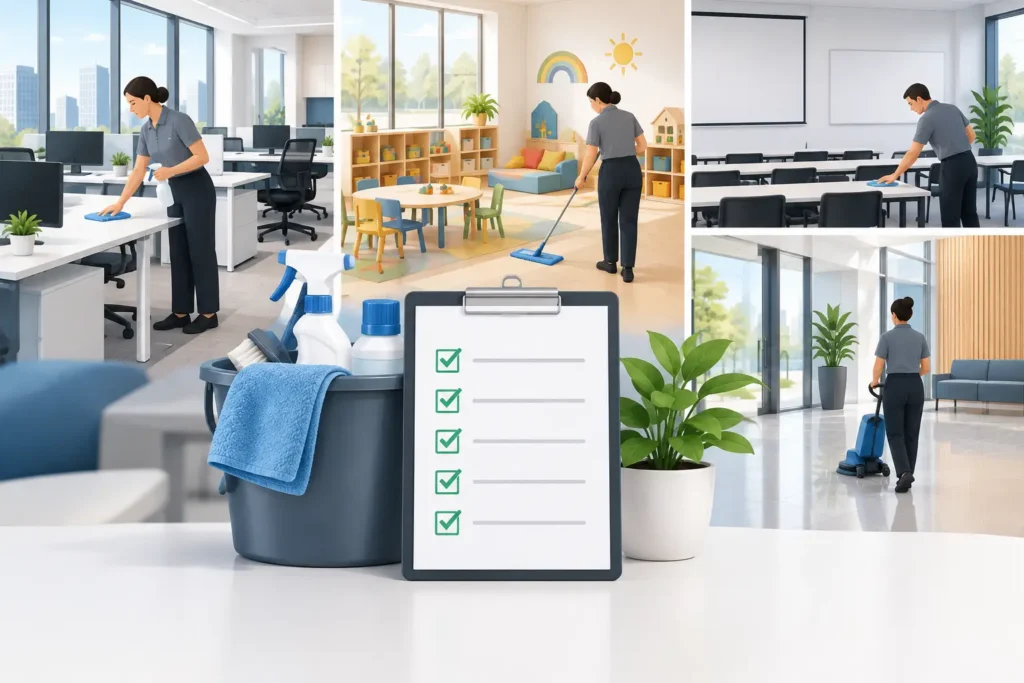
A missed clean is rarely just a dirty bin or an untidy bathroom. For a childcare centre, it can mean a difficult conversation with parents at drop-off. For an RTO, it can distract from preparing for an ASQA audit. In an office or strata foyer, it is often the first thing staff, visitors and tenants notice. Good cleaning procurement is about preventing those avoidable problems by choosing a contractor and a scope of works that hold up night after night.
For organisations across Newcastle, Lake Macquarie and the lower Hunter, the best procurement process is usually straightforward. It starts with an honest view of the site, defines the outcomes required, and asks for practical evidence that the work will be completed as agreed.
Start cleaning procurement with the site, not a generic quote
A quote based on floor area alone is unlikely to reflect how your premises are used. A small early learning centre with busy bathrooms, meal areas and outdoor access points may need more attention than a larger, low-traffic professional office. A training facility may have classrooms used only on certain days, alongside workshops or shared amenities that need regular servicing.
An on-site inspection gives both parties a proper starting point. Walk the contractor through the premises after considering how people actually move through them. Point out high-contact areas, storage constraints, access arrangements, alarm procedures, waste collection points and rooms that need particular care.
Local conditions matter too. Sand and grit tracked in from parks and beaches can quickly affect entryways in Merewether, Caves Beach and Belmont. Coastal salt air can leave windows and glass looking marked sooner than expected. Humid Newcastle summers may change the attention needed in bathrooms, kitchens and poorly ventilated spaces. These are not reasons for vague promises. They are details that should shape the scope of works.
Before inviting quotes, note what has not worked with the current arrangement. It may be missed visits, inconsistent bathroom presentation, rubbish left behind, poor communication, or uncertainty about whether anyone attended. This gives the procurement process a useful purpose beyond simply comparing prices.
Build a scope of works people can inspect
A clear scope of works is the foundation of reliable contract cleaning. It should describe the result you expect and how often it is required, rather than relying on broad terms such as “full clean”. The cleaner needs enough detail to staff the work properly, while your team needs a document that makes quality conversations easier.
For a childcare centre or OOSH service, the scope might distinguish between daily cleaning of bathrooms, meal preparation areas, learning spaces, staff areas and entry points. It should also cover rubbish removal, floor care and any agreed cleaning of toys, furniture or touchpoints, using products and methods suitable for the setting.
This supports a centre’s own approach to hygiene and presentation under the National Quality Framework and National Quality Standard, particularly Quality Area 2, Children’s health and safety, and Quality Area 3, Physical environment. Cleaning does not guarantee compliance or an assessment outcome, but a well-managed arrangement gives nominated supervisors and approved providers better evidence that the physical environment is being cared for consistently. ACECQA guidance, centre policies and directions from the NSW Office of the Children’s Guardian should inform the site’s requirements.
For RTOs, include classrooms, reception, staff rooms, toilets, training kitchens where applicable, and shared student spaces. Consider the timetable as well. A five-night schedule may suit a high-use campus, while a two- or three-visit arrangement can be appropriate for a smaller training facility. The aim is to support an orderly learning environment and the organisation’s own systems under the Standards for RTOs, without disrupting delivery.
Office and workplace scopes should account for workstations, meeting rooms, kitchens, amenities, reception, rubbish, hard floors and vacuuming. In strata common areas, be precise about foyers, corridors, lifts, glass doors, shared amenities and bin areas. If a site has occasional functions, board meetings or tenant move-ins, agree in advance how additional work will be requested and approved.
A useful scope also states what is not included. Window cleaning, carpet steam cleaning, pressure washing and deep cleans may be periodic services rather than part of the recurring visit. Making that distinction early avoids assumptions at school holiday, Christmas shutdown or office relocation time.
Ask how attendance and quality will be verified
A cleaning contractor can promise a great deal at tender stage. The more revealing question is how they will show that the scheduled clean took place.
Ask whether cleaners check in and out on site, and whether those records can be used if a question arises. Technology-verified attendance through an on-site tag or QR code is a practical safeguard for busy managers who are not present after hours. It is not a substitute for checking quality, but it confirms that a visit occurred and gives a starting point when something has been missed.
Also ask who receives and follows up cleaning concerns. A good arrangement has a clear contact person, a simple way to report issues, and a reasonable process for rectification. This matters most when a complaint comes in at 7 am and the building is about to open.
During cleaning procurement, request examples of the quality checks used at similar commercial sites. You are not looking for elaborate paperwork for its own sake. You are looking for a contractor that can identify an issue, respond promptly and keep a record where needed.
Check suitability for the people using the building
For childcare and education settings, workforce screening deserves specific attention. Ask whether cleaners hold current police checks and, where work is undertaken at childcare centres, Working With Children Checks (WWCC). The contractor should understand that a WWCC is part of a broader safeguarding environment, not a box-ticking exercise.
For every site type, discuss after-hours access, keys, alarms and secure areas. Confirm whether the same cleaners are likely to attend regularly and how absences are covered. Consistency can be particularly valuable in centres and offices where cleaners need to understand the layout, security procedures and agreed priorities.
WHS responsibilities should be addressed in practical terms. Under SafeWork NSW expectations, both the workplace and contractor need sensible arrangements for hazards such as wet floors, chemicals, slips, manual handling and secure access. Ask about safety data sheets, storage requirements and how incidents or hazards will be reported. The goal is not to turn a cleaning quote into a legal document, but to make sure routine work is planned responsibly.
Compare proposals on outcomes, not just frequency
Two quotes can both say “five nights per week” while offering very different levels of coverage. Compare them against your scope of works line by line. Look for the visit frequency, specified tasks, periodic work, exclusions, communication method, attendance verification and any assumptions about access or consumables.
Fixed-price, outcome-based billing can make budgeting simpler because the agreed scope, rather than time on site, is the basis for the service. That does not mean every extra request is automatically included. A fair proposal should explain how one-off work or changes to the site will be handled, so there are no surprises later.
Be cautious about choosing purely on the lowest figure. A contractor that has allowed insufficient time or has not inspected the premises may struggle to deliver the standard you need. Reliability, screening, supervision and responsive communication all require a realistic service plan.
It is also worth considering the value of a local operator. If your office in Hamilton has an urgent concern, or your centre in Warners Bay needs additional attention before reopening after a shutdown, you want to know who will respond and how quickly the issue can be assessed.
Make the handover deliberate
Once you appoint a contractor, allow time for a proper start. Provide access instructions, site contacts, alarm requirements, rubbish procedures and a current copy of the scope of works. Walk through the site together if practical, especially where there are areas that look similar but have different cleaning requirements.
Set an early review point after the first few weeks. This is when small gaps are easiest to correct: a bin location missed after a fit-out, a bathroom used more heavily than expected, or a glass entry that needs more frequent attention. A short, direct conversation is usually more useful than letting minor frustrations build.
Newcastle Cleaning Co has worked with local commercial sites since 1962, and the enduring lesson is simple: good cleaning arrangements depend on clear expectations and consistent follow-through. Choose a scope that reflects your building, ask for proof of attendance, and keep communication open. The result is a workplace, training facility or childcare centre that is ready for the next day without adding another task to yours.