
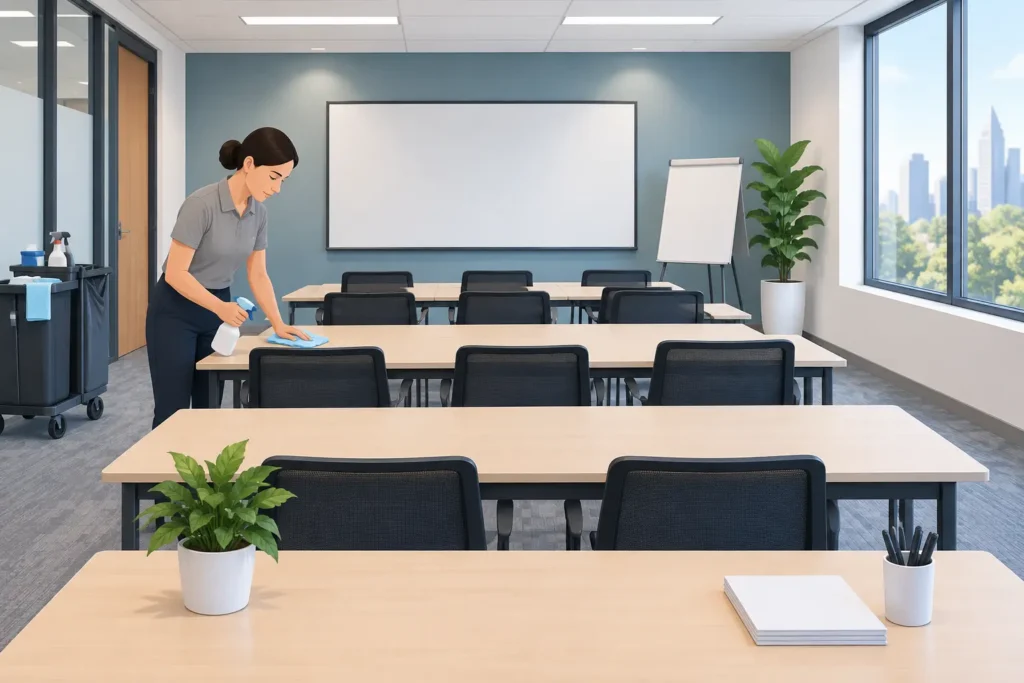
A training room can contain excellent resources and well-organised student records, yet still create doubt when the physical space looks neglected. To prepare training rooms for audits, start with the details an assessor, visitor or student sees immediately: clean entry points, orderly workstations, usable amenities and a room that is ready for learning rather than being hastily reset.
For RTOs, industry association training centres and workplace training facilities, cleaning is not the audit itself. It does, however, support the professional, safe and fit-for-purpose environment expected of a well-run operation. It also removes a common source of last-minute pressure for campus and operations managers.
What an audit-ready training room looks like
ASQA audits assess much more than presentation. The Standards for RTOs cover matters such as governance, training and assessment, learner support, facilities and resources. A clean room will not prove compliance, and it should never be treated as a substitute for current documentation, qualified trainers or suitable equipment.
Still, the condition of the premises matters. An assessor should be able to enter a room without navigating overflowing rubbish bins, dusty ledges, marked glass or furniture left from the previous session. Practical conditions should support the training being delivered.
A typical room check should consider whether floors are clear and clean, tables and chairs are presentable and arranged appropriately, whiteboards are wiped clean, and teaching equipment can be accessed easily. Check blinds, windows, light switches and door handles as well. These high-touch and highly visible areas can make a room feel overlooked when they are not included in the regular scope of works.
The standard required depends on the facility. A computer training room needs clean work surfaces and attention around keyboards, cables and screens in line with the equipment manufacturer’s instructions. A practical workshop classroom may need a more frequent approach to grit, dust and tracked-in debris. A meeting-style training room can require closer attention to glass, presentation walls and visitor-facing details.
Prepare training rooms for audits with a room-by-room walk-through
Avoid relying on a general impression of the site. Walk each training room, reception area, corridor, kitchenette, toilet and store room as if you were unfamiliar with the facility. Do this at least several weeks before an audit or scheduled assessment where possible. A rushed clean the night before can improve surfaces, but it will not resolve accumulated issues, missing supplies or maintenance concerns.
Bring a simple room list and record what needs cleaning, repair, restocking or relocation. Separate cleaning tasks from facilities tasks. For example, a stained carpet may need steam cleaning, while a frayed power cord, faulty blind or loose chair requires repair or replacement. Clear ownership prevents the cleaning team being asked to solve problems outside its role and ensures important hazards are not missed.
Look closely at the areas people often pass without noticing:
- skirting boards, corners and ledges where dust settles
- windows, internal glass and door frames marked by fingerprints
- chair legs, table edges and under-desk areas
- kitchen cupboard fronts, microwaves and shared fridges
- toilet partitions, soap dispensers, bins and floor edges
- entrances where rainwater, sand and leaf litter are tracked inside.
In Newcastle, Lake Macquarie and coastal suburbs, sand and grit can build up quickly at entrances, particularly after wet weather or sessions near beaches and parks. Coastal salt air can also leave windows and external glass looking dull over time. These are sensible items to schedule rather than leave until an audit is booked.
Check that the room supports safe access
WHS obligations extend beyond a room looking tidy. Keep walkways, exits and access to fire equipment clear. Store cleaning chemicals and equipment securely, away from learners and visitors. Remove boxes, spare chairs and outdated materials that have drifted into corridors or behind doors.
If a room is rearranged for a practical activity, reset it afterwards. An unfamiliar visitor should be able to see clear paths through the space and use the room without moving stored items first. If there is a maintenance issue that could affect safety, report it through the site process and retain the relevant record.
Put the regular cleaning scope under an audit lens
An audit preparation clean is most effective when it builds on reliable recurring cleaning, not when it tries to compensate for weeks of missed visits. Review the existing scope of works against the current use of each space. Training rooms that were once used twice a week may now host daily sessions, external groups or evening classes.
Confirm the basics: which rooms are cleaned, how often they are serviced, what happens after a late class, and who is responsible for resetting shared areas. Also consider periodic work that sits outside the routine, such as carpet steam cleaning, window cleaning, high-dusting or pressure washing of external entries.
Humid Hunter summers can make amenities, kitchens and air-conditioned rooms feel tired more quickly if attention is inconsistent. During busy delivery periods, rubbish removal, washroom checks and spot cleaning may need to be adjusted. The right frequency depends on student numbers, room use, weather and whether the facility receives visitors.
For larger campuses or smaller portfolios, use consistent standards across rooms. A compliance manager should not find one room presented well while another has different cleaning frequencies and no clear reason for the difference. Consistency is easier to manage when the scope states the expected outcome for each area rather than only naming a vague service.
Keep simple proof that cleaning occurred
If a concern is raised before or during an audit, staff need a quick way to confirm what was done and when. This does not need to become a complicated paperwork exercise. A current scope of works, a cleaning schedule, site communication records and any completed quality checks provide useful operational evidence.
Technology-verified check-in and check-out can add another practical record that a scheduled service took place. It is particularly useful for after-hours cleaning, when the campus team is not present to see the visit. It does not replace quality inspection, but it helps distinguish a missed clean from a specific quality issue that needs follow-up.
Record exceptions as well. If a training room was unavailable because of a late course, a maintenance contractor or a locked access point, note the agreed alternative arrangement. Clear communication protects the facility from assumptions and allows the next service to prioritise the affected area.
Make responsibilities clear before the audit week
Cleaning contractors, facilities staff and trainers all influence the condition of a room. Set expectations early. Trainers can clear personal materials and advise when a room will be accessible. Site staff can arrange repairs, replace consumables and confirm room layouts. The cleaning team can complete the agreed tasks after hours and report issues found during the service.
A short pre-audit meeting is often more useful than a long email chain. Review access, room bookings, restricted areas, event dates and any presentation requirements. If an evening class runs later than usual, agree whether the room will be cleaned afterwards or first thing before the next session.
Plan around closures and peak activity
School holiday and Christmas shutdown periods are a practical opportunity to complete deeper work without interrupting learners. Carpet steam cleaning, detailed window cleaning and high-dusting are easier when rooms are vacant and furniture can be moved safely. Book these services early if the closure period is short.
For an audit during a busy term, avoid trying to deep clean every room at once. Prioritise audit-facing spaces first, then schedule remaining tasks around delivery. A staged plan is often more realistic and creates less disruption for trainers and students.
After the audit, keep the improvements that made the biggest difference. A clear room standard, dependable after-hours cleaning and a simple reporting process are easier to maintain than an occasional pre-audit scramble. That gives staff, learners and visitors a training facility that is ready for scrutiny on any ordinary weekday, not just the day an assessor arrives.