
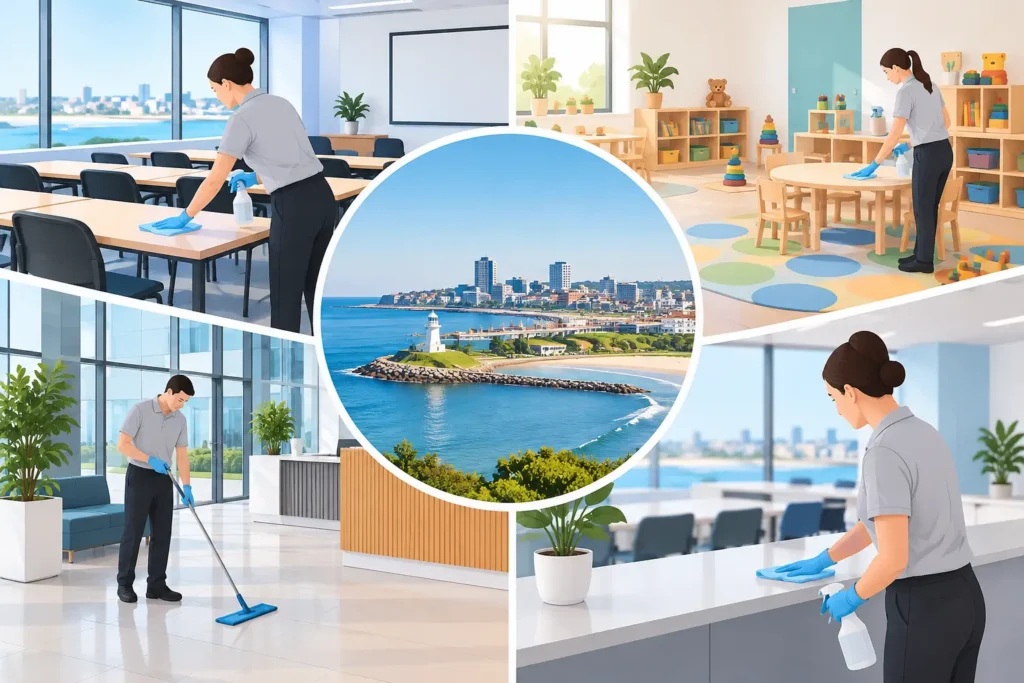
A wet morning can change a centre or training facility before the first child, student or staff member arrives. Sand and grit from local parks and beaches ends up at entrances, wet amenities need closer attention, and a missed evening clean is immediately visible. Education hygiene trends 2026 are less about adding unnecessary tasks and more about building dependable, documented cleaning around the way each site actually operates.
For centre directors, OOSH coordinators and RTO operations managers, the practical question is straightforward: does the cleaning scope leave the premises safe, presentable and ready for the next day, every time? The answer depends on clear priorities, reliable attendance and regular review rather than a generic checklist.
Education hygiene trends 2026: proof matters as much as presentation
A clean-looking room is still essential, but education providers increasingly need a dependable record that agreed work has occurred. This is particularly relevant for multi-site early learning providers, community preschools managed by volunteer committees and RTOs with campus managers who are not present after hours.
Technology-verified check-in and check-out gives a useful record of each visit. It does not replace quality inspections, but it answers the basic question of whether the cleaner attended the site. Pair that record with periodic site checks and a written scope of works, and the cleaning arrangement is much easier to manage when there is a parent query, a staff complaint or a change in site leadership.
The trend is towards outcome-based accountability. Rather than focusing only on time spent on site, decision-makers are looking for agreed results: amenities reset, floors free of visible debris, rubbish removed, touchpoints cleaned, and entry areas ready for opening. Fixed-price, outcome-based arrangements can suit this approach because the discussion stays centred on the condition of the site, not a running clock.
Cleaning plans are becoming more site-specific
One checklist cannot sensibly cover an early learning centre, an OOSH service and an RTO training facility. They may all have classrooms, amenities and shared entrances, but the patterns of use are different.
Early learning and OOSH sites need routines around real use
In childcare centres, cleaning priorities often follow the busiest parts of the day: meal areas, bathrooms, sleep rooms, reception spaces and high-contact furniture. A good after-hours scope should be clear about which rooms require daily attention, which areas need a more detailed weekly clean and who is responsible for site-specific tasks such as emptying outdoor bins or restoring chairs after an activity.
OOSH services can have a different rhythm again. Shared school halls, kitchens and multipurpose rooms may be used intensively in short windows, often with sports equipment, craft materials and outdoor dirt brought inside. The cleaning plan needs to account for that, especially during wet or humid Newcastle summers when floors can take longer to dry and odours can develop in poorly ventilated spaces.
Cleaning supports the National Quality Framework and National Quality Standard, particularly Quality Area 2, Children’s health and safety, and Quality Area 3, Physical environment. It is one practical part of maintaining a suitable environment, not a substitute for a service’s own policies, staff supervision, maintenance program or compliance responsibilities. ACECQA guidance and requirements administered by the NSW Office of the Children’s Guardian should remain part of each service’s wider operational planning.
RTOs need cleaning that reflects delivery, not just room type
For RTOs, a training room used for theory sessions has different needs from a workshop-style training space, reception area or student breakout room. Tables, whiteboards, shared equipment surfaces, amenities and entry points may need different frequencies depending on class schedules and enrolment peaks.
A practical scope also identifies boundaries. General commercial cleaning can maintain training rooms, common areas and amenities, while specialised equipment, hazardous materials or technical maintenance may require another provider or the RTO’s own procedures. Clear boundaries prevent assumptions and make it easier to meet the operational expectations behind the Standards for RTOs without suggesting that cleaning alone determines audit outcomes.
Entrances and amenities are receiving closer attention
First impressions are not superficial when they involve floors, bathrooms and reception areas. Parents, students and visitors notice these spaces before they see the rest of the building, and staff are often the first to report when standards slip.
In Newcastle and Lake Macquarie, entrances can collect sand, leaf matter and grit quickly. A centre near parks, a Cardiff training facility with a busy car park, or an office-linked education site in Charlestown may need more than a quick vacuum at the door. Matting, regular spot cleaning and a scope that allows for seasonal changes can reduce tracked-in dirt across corridors and classrooms.
Amenities deserve the same clarity. The cleaning scope should state how often toilets, basins, mirrors, dispensers, bins and floors are cleaned, and how consumables are managed if they are included. A vague instruction to clean bathrooms creates room for disagreement. A defined standard gives the cleaner and site manager something useful to check.
Ventilation, dust and windows are part of the conversation
Education sites are paying more attention to the overall condition of indoor spaces, including visible dust, stale-smelling rooms and marked windows. Cleaning is only one element of indoor environmental quality, alongside building maintenance, ventilation systems and sensible room use. It should not be presented as a solution to issues that require a maintenance contractor or specialist advice.
What regular cleaning can do is keep accessible vents and surfaces free of visible dust, reduce buildup on ledges and furniture, and maintain common areas so problems are easier to spot. Coastal salt air can leave windows and glass doors looking dull sooner in suburbs closer to the water, while fingerprints on reception glass and classroom doors quickly affect presentation.
Periodic window cleaning, carpet steam cleaning and closure-period deep cleans are becoming more common where daily cleaning alone is not enough. These services work best when planned around school holidays, term breaks or Christmas shutdowns, rather than being arranged only after the site has deteriorated.
Safer product choices need clear communication
There is growing scrutiny of what is used in spaces occupied by children, students and staff. The sensible response is not to chase marketing labels. It is to make sure products are suitable for the task, used according to directions, stored appropriately and supported by safety information where required.
For childcare and education sites, managers should ask how products are selected, whether cleaners understand site procedures and how spills or concerns are reported. Fragrance preferences can vary, especially in smaller rooms, so this is worth discussing before a contract begins. The right approach depends on the site, its occupants and the products needed for particular surfaces.
This also connects to SafeWork NSW and broader WHS obligations. A contractor should work within the site’s access, storage and hazard-reporting procedures, while the site should provide clear information about known risks, restricted areas and any changes to the premises.
Turn the trend into a workable scope of works
The most useful hygiene trend for 2026 is simple: make expectations visible before problems arise. An on-site inspection is the right starting point because cleaning needs cannot be assessed properly from a floor plan or a short phone call.
When reviewing a cleaning proposal, make sure the scope of works covers these distinct points:
- the rooms, amenities, entry areas and shared spaces included at each visit
- daily, weekly and periodic duties, including closure-period deep cleaning
- access arrangements, alarm procedures and after-hours communication
- attendance verification, quality checks and how missed or incomplete work is addressed
- staff suitability for the site, including police checks and Working With Children Checks (WWCC) where required
- consumables, waste arrangements, exclusions and responsibility for reporting maintenance issues.
For early learning and education settings, staffing checks are not an administrative detail. Cleaners working in relevant environments should hold the appropriate WWCC and police check, with processes that respect the site’s own child-safe practices. For all sites, consistency matters just as much as credentials: familiar, reliable cleaners are better placed to notice when a bin area, entry mat or bathroom routine needs attention.
Plan for the local calendar, not just the weekly clean
A five-night cleaning arrangement may be right for a busy centre or campus, while a smaller training facility may need fewer visits. There is no universal frequency. The better test is whether cleaning is keeping pace with foot traffic, operating hours and the site’s expected standard by the next opening.
Review the plan before high-use periods, wet-weather seasons and long closures. School holiday deep cleans can address carpets, windows, detailed kitchen cleaning and hard-to-reach areas without disrupting programs. Christmas shutdowns are also a practical time for pressure washing, where suitable, and a full reset before staff and families return.
At Newcastle Cleaning Co, every recurring contract begins with an on-site inspection and a written fixed-price scope, because a dependable clean starts with understanding the site rather than making assumptions. For 2026, the most valuable hygiene improvement may simply be a cleaning plan that is specific, checked and dependable enough that your team can stop thinking about it.