
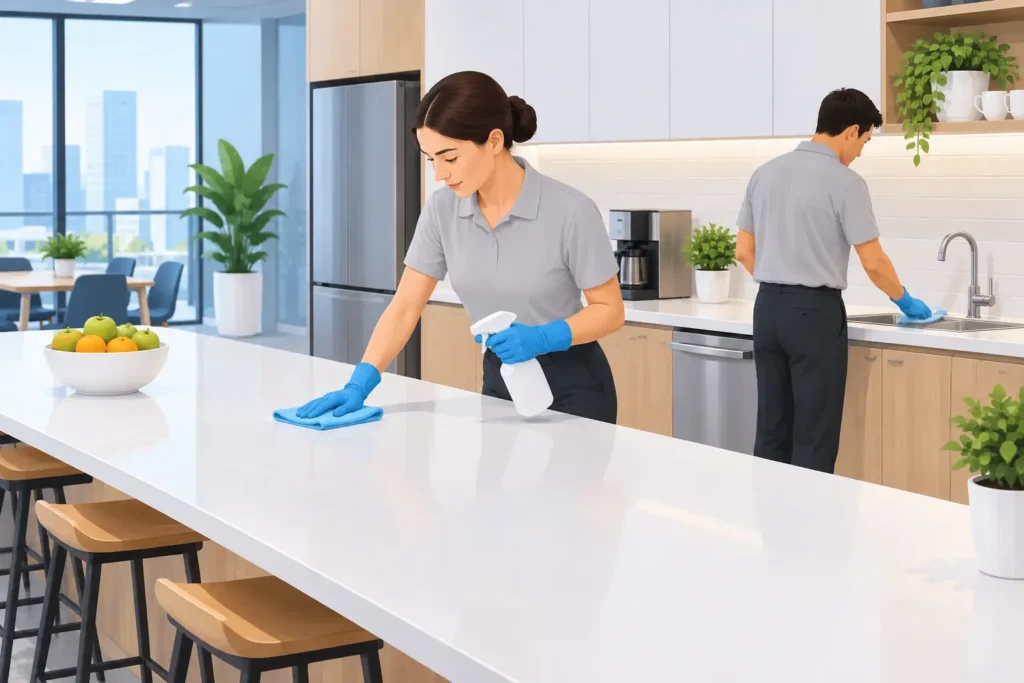
The office kitchen often tells staff and visitors more about a workplace than the boardroom does. A full sink, sticky fridge handle or overflowing rubbish bin quickly undermines confidence in the rest of the premises. To clean office kitchens hygienically, the work needs a clear routine, sensible product use and shared responsibility between staff and the cleaning contractor.
For workplaces across Newcastle, Lake Macquarie and the lower Hunter, the challenge is usually not a lack of good intentions. It is that several people use the same compact space throughout the day, then assume someone else will deal with the mess. A practical system keeps the kitchen usable without interrupting the working day.
What hygienic office kitchen cleaning involves
A hygienic clean is more than making benches look presentable. It removes food residue, spills, grease and rubbish from the places people touch and prepare food. It also deals with the overlooked areas that can create odours or attract pests, including the microwave, refrigerator seals, bin surrounds and the floor beneath cupboards.
The required frequency depends on the kitchen and how it is used. A small professional office where staff make tea and heat lunch may need a thorough clean each evening and a more detailed fridge clean each week. A busy training facility, community service workplace or shared office with frequent visitors may need additional attention during the day or a more detailed after-hours scope of works.
Good cleaning supports a safe and orderly workplace, but it does not remove the need for staff to store food appropriately, report maintenance faults and clean up personal spills. Those responsibilities work best when they are stated plainly.
Start with a practical kitchen cleaning scope
A written scope of works avoids the common problem of assuming the cleaner will handle every kitchen task. It should distinguish between routine daily work, periodic tasks and responsibilities that remain with the workplace.
Routine after-hours cleaning commonly includes wiping and cleaning benchtops and tables, cleaning sinks and taps, emptying rubbish and recycling, cleaning the microwave inside and out, wiping external appliance surfaces, cleaning touchpoints such as fridge handles and cupboard pulls, and mopping the floor. The cleaner should also check for obvious spills, food debris and rubbish around the bins.
Periodic tasks may include cleaning inside the refrigerator, wiping cupboard interiors, treating built-up grease around splashbacks, moving light items to clean beneath them, and cleaning walls where marks have accumulated. These jobs need an agreed frequency. If nobody owns them, they are often left until a smell or complaint makes the issue urgent.
Staff responsibilities are usually simple: label and remove personal food, wash their own dishes where this is the workplace rule, report leaks or appliance faults, and avoid leaving food on benches overnight. A kitchen sign can help, but clear induction instructions and a regular reminder are more effective than a long list taped to the wall.
Include the details that affect hygiene
The scope should say what happens to dishes, drying racks and shared coffee equipment. Some workplaces expect cleaners to stack clean dishes left on a rack. Others prefer that cleaners do not handle personal crockery at all. Neither approach is automatically right, but the expectation should be agreed.
Also specify whether the refrigerator is cleaned only when empty, whether cleaners can dispose of unlabelled food after a set date, and who approves the disposal. This is especially useful in larger offices and multi-tenant spaces, where a fridge clean can otherwise become a point of disagreement.
Use the right sequence, not just more product
A reliable process usually starts high and dry, then moves to food-contact and touch surfaces, before finishing with bins and floors. Crumbs and loose debris should be removed before benches are wiped. Sinks, taps and appliances should be cleaned with separate cloths or colour-coded equipment rather than using the same cloth across every surface.
Cleaning products should be suitable for the surface and used according to the manufacturer’s directions. More chemical is not necessarily better. Overuse can leave residue, damage finishes or create strong odours in a small room. Food preparation surfaces need to be left clean and ready for use, not simply perfumed.
The order matters because bin lids, sink drains and floors carry different soil from a lunch table or kettle handle. Changing cloths and cleaning equipment between tasks reduces the chance of transferring grease or residue back onto cleaner surfaces. Mop heads and cloths also need laundering or replacement on a planned cycle.
In humid Newcastle summers, rubbish and food scraps can become unpleasant quickly. Bins should be emptied at each scheduled clean, liners replaced as needed, and the inside and outside of the bin cleaned when spills occur. If the kitchen has an outdoor bin area, make sure food waste is not accumulating around it.
Give high-touch areas proper attention
The most visible mess is not always the most frequently handled. Fridge doors, microwave buttons, kettle handles, coffee machine controls, cupboard pulls, taps, light switches and the kitchen door handle should be part of the routine, not an occasional extra.
A typical example is a shared kitchen in a Hamilton or Charlestown office where staff arrive at different times and visitors use the facilities during meetings. The bench may be cleaned after lunch, but the fridge handle and coffee machine can be touched all day. Including these surfaces in the evening clean provides a consistent reset for the next morning.
Appliances need sensible care. Microwaves should be cleaned after splatters rather than waiting for residue to bake on. Coffee machines may require daily emptying of drip trays and grounds containers, while their internal maintenance follows the manufacturer’s instructions. Cleaners can handle agreed external and routine tasks, but a nominated staff member may need to manage specialist maintenance, filters or descaling.
Manage floors, drains and hard-to-reach edges
Kitchen floors collect dropped food, drips and grit tracked in from car parks, footpaths and nearby parks. In coastal suburbs, sand can be a regular issue, particularly after wet weather or when staff come in from beaches. Sweeping or vacuuming loose debris before mopping prevents grit being spread across the floor.
Pay attention to the edges around cupboards, beneath the fridge where accessible, and behind bins. These are the places where food debris can sit unnoticed. A regular detailed clean is usually more effective than trying to add every deep-clean task to the nightly visit.
Drains deserve a clear reporting process. A cleaner can remove visible debris and report slow drainage, odours or leaks, but plumbing faults need prompt attention from the appropriate tradesperson. Avoid treating recurring odours with more fragrance or chemical products when the underlying issue may be a damaged seal, blocked drain or appliance leak.
Make hygiene visible through accountability
A kitchen routine only works if somebody can confirm it happened. For office and facilities managers, this is particularly valuable when cleaning occurs after hours and staff do not see the work being completed.
Technology-verified check-in and check-out records provide a straightforward attendance record for each visit. They do not replace quality checks, but they help separate a missed clean from a concern about the standard of work. Periodic inspections, a simple communication channel for issues, and a scope that can be updated when the workplace changes all support consistency.
This is relevant for strata common areas with shared tea points as well as standalone offices. In a building foyer or shared kitchenette, unclear responsibility can leave bins, spills and supplies unattended. Agreeing the cleaning boundary between the tenant, building manager and contractor prevents avoidable gaps.
Review the kitchen after changes to the workplace
A new fit-out, a larger team, hybrid work patterns or a change in tenancy can alter how the kitchen is used. The existing cleaning scope may no longer match the space. If a new coffee machine, dishwasher or larger refrigerator has been installed, check whether the routine covers it and whether additional periodic cleaning is needed.
For RTOs and education providers, busy enrolment periods can increase use of staff kitchens and breakout areas. For childcare centres and OOSH services, staff kitchens need to be managed carefully alongside the centre’s own food handling and cleaning procedures. Good commercial cleaning can support the National Quality Framework and National Quality Standard, particularly Quality Area 2 and Quality Area 3, but it should sit within the service’s broader documented practices.
School holiday and Christmas shutdown periods are also a sensible time to arrange deeper kitchen cleaning. Cleaning cupboard interiors, refrigerator surrounds, walls, windows and neglected edges is easier when the site is quiet and appliances can be emptied. Coastal salt air can also leave a film on kitchen windows in places such as Merewether and Belmont, so window cleaning may be worth including in a shutdown plan.
A hygienic office kitchen is built through ordinary tasks completed reliably: benches reset, bins emptied, touchpoints cleaned, floors attended to and problems reported before they grow. With a clear scope and dependable after-hours service, the kitchen can be one less issue for a busy manager to chase.