
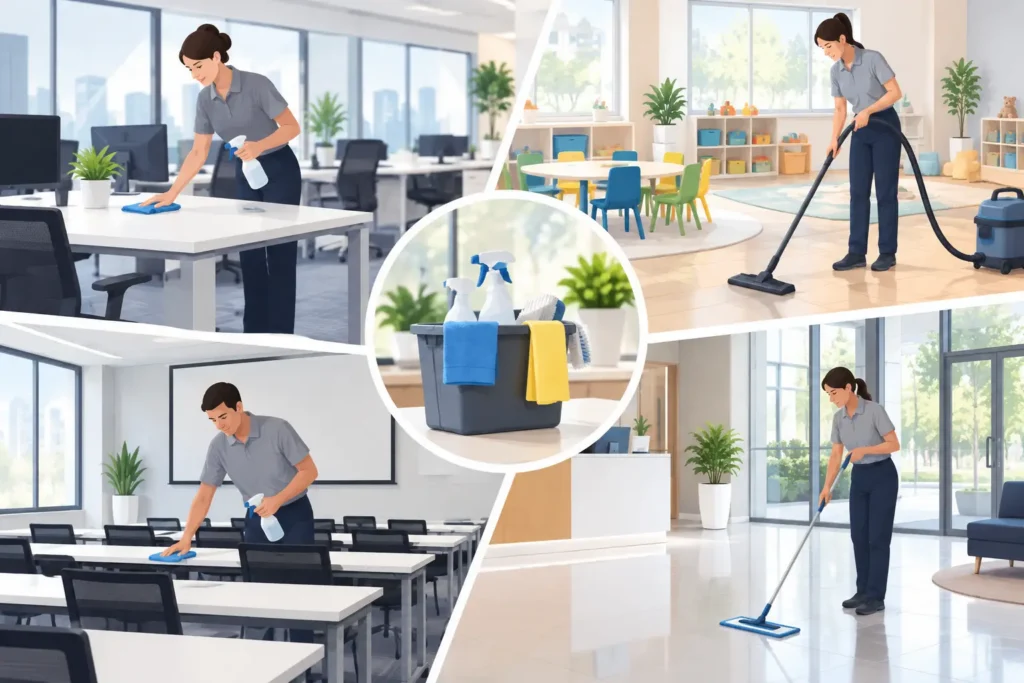
School holidays can be one of the few times a commercial site is quiet enough to address the cleaning jobs that are difficult to complete during normal operations. The best school holiday cleaning tasks are not simply a longer version of the regular clean. They are targeted jobs that improve the condition, presentation and usability of the workplace before children, students, staff and visitors return.
For a childcare centre, RTO, office or strata common area, the right priorities depend on how the space is used and how long it will be closed or operating at reduced capacity. A centre with holiday care still running needs work staged around attendance. An RTO may have a clear training facility for a week, while an office may use the Christmas shutdown to complete carpet cleaning or window cleaning without interrupting staff.
Start with an inspection and a clear scope of works
Before booking a holiday clean, walk through the site and separate routine tasks from periodic work. Look at the areas that receive constant traffic, the spaces that are usually occupied, and the items that regular after-hours cleaning can only maintain rather than thoroughly restore.
A practical inspection should cover entry points, amenities, kitchens, floors, windows, storage areas and high-use furniture. It is also a good time to note maintenance issues such as damaged flooring, leaking taps, mould-prone grout or window tracks that need repair. Cleaning can support a well-maintained environment, but it cannot correct a building defect.
Put the agreed tasks into a written scope of works. This avoids the common problem of assuming a deep clean includes every cupboard, wall or external surface. For example, carpet steam cleaning, pressure washing and internal window cleaning are separate services that need to be clearly identified, along with access requirements and the preferred completion date.
Best school holiday cleaning tasks to prioritise
The most worthwhile work is usually found in areas that are busy during term time or normal business hours. These tasks should be selected for the site, not added automatically.
Refresh floors beyond the daily clean
Floors carry sand, grit and moisture into buildings, particularly around Newcastle and Lake Macquarie where beaches, parks and wet weather can make entryways hard to keep tidy. During humid summers, grime can also build up quickly in amenities and on hard floor edges.
Holiday periods are a sensible time for carpet steam cleaning in classrooms, training rooms, offices, meeting rooms and shared corridors. It allows sufficient drying time before the building reopens. Hard floors may benefit from a detailed clean of edges, corners and areas beneath movable furniture, while entry mats should be assessed for embedded dirt and wear.
Take care with timing. If furniture or equipment needs to be moved, confirm who is responsible and where it can be placed. A cleaning contractor should not move heavy filing units, specialised training equipment or centre resources without prior agreement.
Deep clean amenities, kitchens and break areas
Amenities receive steady use but are often difficult to take out of service for more than a short period. A school holiday closure creates time for closer attention to tiled walls, grout, partitions, exhaust surrounds, hand basins, taps, dispensers and floor edges.
In kitchens and staff rooms, focus on the places where crumbs, spills and grease collect: behind small appliances, inside accessible cupboards, on splashbacks, around bins and beneath movable furniture. Fridge cleaning should be planned carefully. Staff need notice to remove food, and any items left behind should be handled according to the site’s directions.
For childcare centres and OOSH services, these tasks support the everyday expectations of the National Quality Framework and National Quality Standard, particularly Quality Area 2, Children’s health and safety, and Quality Area 3, Physical environment. They do not guarantee compliance, but a clean, orderly environment makes it easier for educators and managers to maintain their own hygiene and supervision processes.
Address windows, glass and entry presentation
Windows are easy to overlook when a building is occupied. Finger marks on glass doors, dusty window tracks and marks around entryways affect the first impression of a site, especially where parents, students, clients or visitors arrive throughout the day.
Coastal salt air can leave a visible film on external glass in suburbs closer to the coast, while pollen and road dust can affect sites around Broadmeadow, Mayfield, Waratah and Cardiff. A planned window clean during the shutdown can cover internal glass, accessible external windows, entry doors and glass partitions without disrupting the workday.
Window cleaning has practical limits. Access, height, weather and the condition of the glass all matter. Discuss these during the inspection so the scope is realistic and safe.
Clean behind, beneath and inside accessible furniture
Regular cleaners can clean around desks, chairs, shelves and storage units. Holiday cleaning is the opportunity to deal with the places normally hidden by daily activity. This may include vacuuming beneath desks, wiping chair bases, cleaning inside empty lockers, removing rubbish from accessible storage spaces and cleaning behind movable cabinets.
For early learning centres, include low shelves, cot rooms, educator workspaces and resource storage where access is available. Ask the centre team to sort resources and remove personal items first. Cleaning is more effective when cupboards are not being used as a substitute for storage decisions.
At RTOs, consider training room furniture, whiteboards, lecterns, breakout spaces and workshop-adjacent administration areas. Training providers preparing for an ASQA audit or working under the Standards for RTOs may also value a cleaner, better-organised environment for staff and learners. That said, cleaning should sit alongside, not replace, the provider’s own documented systems and facility responsibilities.
Manage rubbish, storage and forgotten items
A shutdown clean often reveals accumulated cardboard, broken chairs, expired kitchen supplies and boxes left in corridors. These can make a site look untidy and can create avoidable access issues.
A cleaning team can remove normal agreed rubbish and leave areas tidy, but disposal of confidential documents, electronic waste, chemicals, bulky items and hazardous materials requires specific instructions and appropriate arrangements. Offices should also secure files before cleaners arrive. In shared strata areas, make sure residents or tenants have been advised if access or rubbish arrangements will change.
Pressure wash suitable external areas
Pressure washing can make a marked difference to entries, footpaths, courtyards and outdoor common areas where dirt, leaves and tracked-in grit have built up. It can be particularly useful after a wet period or before reopening following the Christmas closure.
It is not suitable for every surface. Painted finishes, damaged concrete, loose pavers and drainage-sensitive areas need assessment first. Water use, runoff and slip risks should be managed under the site’s WHS arrangements, with work scheduled so surfaces have time to dry before people return.
Plan around the people still using the site
Not every school holiday period means an empty building. Childcare centres may operate with smaller groups, OOSH programs may be busy during the day, and offices can have a reduced but still active team. In these cases, schedule disruptive tasks after hours or split them across several visits.
The cleaner should know which rooms are off limits, who is responsible for opening and locking up, and whether alarms or access cards are involved. For childcare and education sites, ensure personnel requirements are appropriate to the environment, including police checks and Working With Children Checks where required. This supports the safeguards expected by organisations such as ACECQA and the NSW Office of the Children’s Guardian.
A reliable contractor should also be able to confirm attendance. Technology-verified check-in and check-out records provide a simple record that the scheduled clean took place, which is useful when managers are away during a shutdown or overseeing several sites.
Use the break to reset the regular cleaning plan
The holiday clean is also a useful test of whether the current routine is keeping pace with the site. If the same issues repeatedly appear – full bins, neglected corners, marked glass or poorly presented amenities – the answer may be a revised routine rather than a larger annual clean.
Review the frequency of visits, the consumables supplied, the rooms included and any seasonal duties. A childcare centre may need more attention to entryways during wet weather. An office in Newcastle CBD may need regular glass cleaning. A training facility may need extra support before each intake or assessment period.
For businesses across Newcastle, Lake Macquarie and the lower Hunter, the most effective shutdown cleaning is planned early, clearly scoped and completed without adding pressure to the team managing the site. Newcastle Cleaning Co has provided after-hours commercial cleaning since 1962, with fixed-price scopes and verified attendance for organisations that need dependable follow-through.
A well-planned holiday clean should leave the building ready for its next busy period, while giving managers a clearer picture of what needs attention before the next closure.