
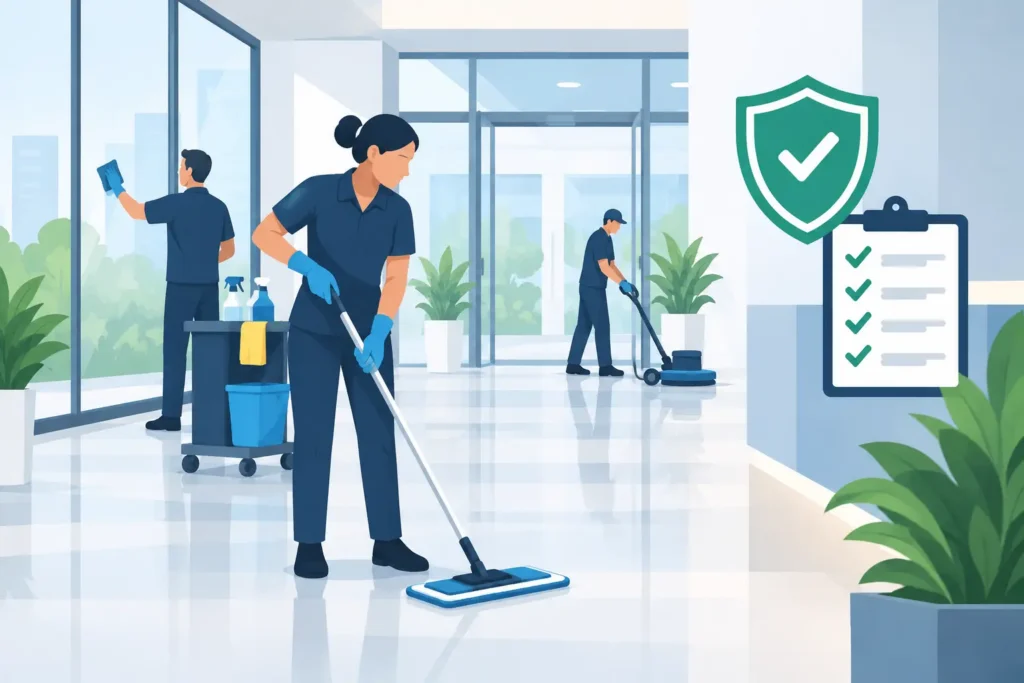
A missed bin, poorly cleaned bathroom or neglected high-touch surface can quickly become more than a cleaning issue. For a childcare centre, it can affect family confidence and everyday hygiene. In an office, it can undermine the experience of staff and visitors. At an RTO, it can distract from the professional standard expected by students, trainers and auditors. Cleaning compliance is the practical discipline of making sure the required cleaning is planned, completed and able to be demonstrated.
It is not about creating paperwork for its own sake. It is about having a reliable system that supports a safe, hygienic and presentable workplace every day, including when schedules change, a staff member is away or an inspection is due.
What Cleaning Compliance Means in Practice
Cleaning compliance means your cleaning arrangements reflect the real risks and operating needs of your site. The right standard will vary between a preschool room used by toddlers, a busy office kitchen and an RTO training space, but the underlying principle is the same: critical areas are cleaned to an agreed standard, at the right frequency, by people who understand the site.
For childcare and preschool operators, this usually means close attention to bathrooms, nappy-change areas, eating spaces, floors, touchpoints and child-accessible surfaces. The work needs to fit around children and educators without compromising hygiene. Safe chemical handling, secure storage and appropriately checked staff matter just as much as a clean visual result.
Office cleaning compliance is often tied to workplace presentation, staff comfort and maintaining shared amenities. Entry areas, meeting rooms, kitchens, bathrooms and rubbish removal all contribute to whether the workplace feels organised and professionally managed. Frequency may need to increase after a large meeting, event or period of high occupancy.
For RTOs, cleanliness supports the professional environment students and auditors expect to see. Training rooms, reception areas, amenities and common spaces should be consistently maintained. Cleaning alone will not meet every compliance obligation, but a documented, dependable cleaning program supports orderly operations and helps prevent avoidable concerns about the condition of the premises.
Building a Cleaning Compliance Plan That Works
A useful plan begins with an inspection, not a generic task list. Walk through the site at the times it is busiest and quietest. Consider how people use each room, where contamination or mess is most likely, which areas are visible to families, visitors or auditors, and what access restrictions apply.
Define standards by area, not by vague promises
“Clean the bathrooms” leaves too much open to interpretation. A better instruction identifies the outcome: fixtures sanitised, floors mopped, dispensers checked, mirrors cleaned, rubbish removed and supplies reported when low. The same approach applies to kitchens, classrooms, training rooms and shared desks.
Clear standards help cleaners work consistently, but they also make quality checks fair. Your facility manager and cleaning provider should be able to look at the same area and understand what an acceptable result looks like. This reduces the frustration that can arise when a service sounds comprehensive but essential details are assumed rather than agreed.
Match frequency to risk and use
Not every surface requires the same attention every night. High-touch points such as door handles, taps, handrails, switches and shared equipment may need more frequent cleaning than low-use storage areas. Bathrooms and kitchens generally need close attention, while periodic work such as internal glass, detailed floor care or high dusting can be scheduled separately.
The right frequency depends on site traffic, operating hours, the age and needs of occupants, and the activities conducted on site. A childcare centre after a busy week may need a different focus from a lightly occupied professional office. An RTO with changing class timetables may need cleaning arranged around evening delivery or assessment periods. A plan should be specific enough to guide daily work, while flexible enough to respond to genuine changes.
Make responsibility visible
Compliance is weakened when everyone assumes someone else has handled a task. Agree who reports spills, damaged fittings, pest concerns, low consumables or an area requiring extra attention. The cleaning team should know who to contact, while your on-site team should know how to request additional duties without disrupting the normal schedule.
A dependable provider will also have its own checks. Technology-tracked check-in and check-out provides a simple record that staff attended the site. It does not replace quality inspection, but it adds useful accountability and supports risk management when questions arise about access or attendance.
Records Turn Cleaning Into Evidence
A clean site should be the first sign that the system is working. Records are there to support that result, not to hide a poor one. Depending on your facility, practical evidence may include an agreed scope of work, cleaning schedules, completion records, periodic quality inspections, issue reports and communication about extra duties.
Keep the system proportionate. A small office does not need the same documentation as a multi-room education facility with several daily cleaning requirements. However, every commercial site benefits from being able to answer a few simple questions: What was meant to be cleaned? When was it done? Who can respond if something was missed? How are recurring issues addressed?
This evidence is particularly useful when management changes, an audit is approaching or a concern is raised. Rather than relying on memory, you have a clear reference point for the agreed service and the action taken. It also creates a constructive basis for conversations with your contractor. If a particular room regularly needs extra work, the schedule or scope can be adjusted before it becomes a larger problem.
The Right Cleaner Is Part of Compliance
Even a well-written plan will fall short if the cleaning team is unreliable, rushed or unfamiliar with the site. When assessing a provider, look beyond a headline price. Ask how staff are trained, how attendance is monitored, how quality is checked and how additional requests are managed.
For childcare and education settings, confirm that the provider can supply police-checked staff and Working With Children Checks where required. Ask how cleaners are briefed on site-specific access arrangements, chemical storage, sensitive spaces and the need to work carefully around children, students and staff. For offices and RTOs, discuss after-hours access, alarm procedures, keys, building rules and the process for reporting maintenance concerns.
The commercial model also matters. End-result billing based on an agreed scope can give facility managers more certainty than hourly arrangements where the finished standard is unclear. It works best when the original scope is detailed and both parties understand what is included, what is periodic and how extra work is approved.
Newcastle Cleaning Co. has operated as a local commercial cleaning provider since its incorporation in 1962. Its approach is built around scheduled service, trained staff, detailed standards and flexibility when a site needs more than the routine clean. For busy managers, that combination helps make cleaning one less operational uncertainty.
Review Before a Problem Forces the Issue
Cleaning requirements change quietly. A new classroom opens, office attendance increases, a training room changes use or a family raises a concern about an amenity area. Review the cleaning plan after these changes rather than waiting for dissatisfaction to build.
A short site walk-through with your cleaning provider can identify worn floors, overlooked touchpoints, changing rubbish volumes or access issues that affect the quality of the service. It is also the right time to confirm that the schedule still suits your operations. The best cleaning arrangement is rarely the one with the longest list of tasks. It is the one that consistently protects the areas that matter most to your people, your visitors and your organisation.
When cleaning is planned, checked and supported by responsive communication, compliance becomes part of normal operations rather than a last-minute scramble before someone comes through the door.