
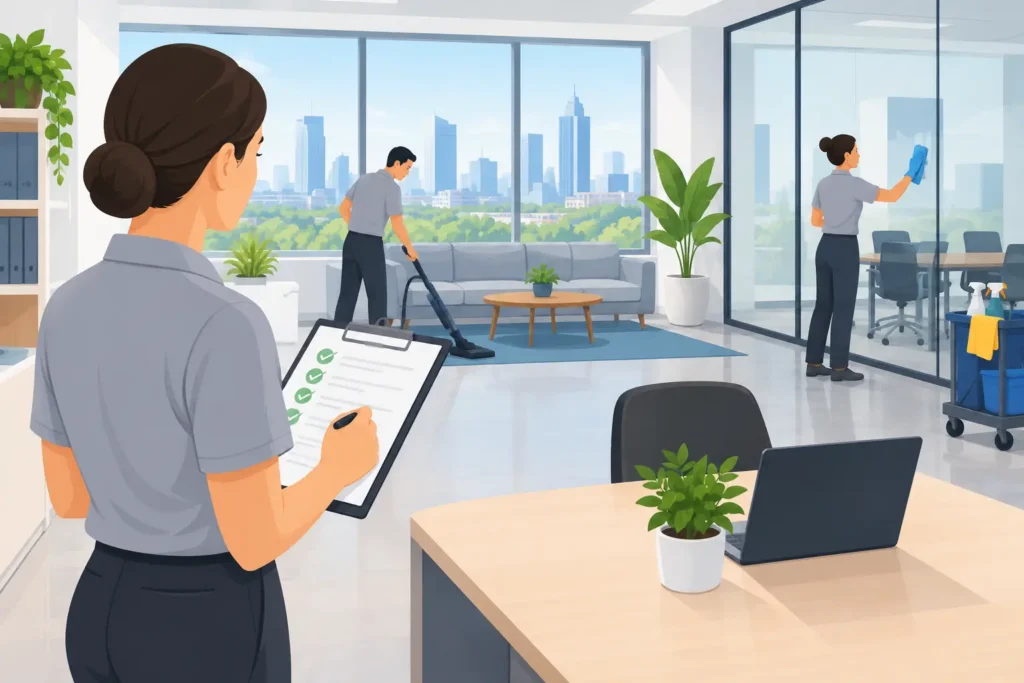
A cleaner arriving after hours is only part of the job. The real question is whether the agreed result is there when staff, children, students and visitors return. Knowing how to audit cleaning quality gives you a fair, repeatable way to answer that question without relying on occasional complaints or a quick glance around the site.
For a childcare centre, training facility, office or strata common area, a useful audit checks the condition of the premises, confirms the cleaning visit occurred and identifies issues early enough to correct them. It should be practical enough for a busy centre director or facilities manager to complete, yet specific enough to support a meaningful discussion with the cleaning contractor.
Start with the agreed scope of works
A cleaning audit cannot be fair if nobody is measuring against an agreed standard. Begin with the written scope of works and separate routine duties from periodic tasks.
Routine duties may include emptying bins, cleaning amenities, vacuuming or mopping floors, wiping touchpoints, cleaning kitchen and lunch areas, and tidying entry points. Periodic work could include internal windows, carpet steam cleaning, pressure washing or detailed cleaning during school holiday and Christmas shutdown periods.
Check that the document identifies frequency as well as the task. For example, a foyer may be vacuumed each visit, while internal glass is cleaned weekly. If the scope says “as required”, define what that means. Vague wording is often where expectations drift.
For multi-site early learning providers or RTOs, allow for site differences. A centre near Caves Beach may need more attention to sand and grit at entries than a Newcastle CBD office. A training workshop may need a different cleaning sequence from a classroom. The audit should test the agreed outcome for that location, not apply one generic checklist to every building.
How to audit cleaning quality on site
Walk the premises at a consistent time. First thing in the morning, before staff begin work or children arrive, is usually best for after-hours cleaning. Audit at least once a week at the beginning of a new arrangement, then move to a regular monthly check once standards are steady. More frequent checks may be sensible after a complaint, staff changeover, fit-out or major event.
Use the same route each time: entrance, shared spaces, kitchens or staff rooms, amenities, work or learning areas, then storage and rubbish points. A consistent route makes changes easier to spot and prevents the cleanest areas from shaping your overall impression.
Check outcomes, not just effort
Look for observable results rather than trying to judge how hard someone worked. Floors should be free of visible litter, excessive dust, sticky residue and tracked-in dirt. Bins should be emptied as specified, relined where required and free from spills around the base. Amenities should be presentable, supplied according to the scope and without obvious residue on basins, taps, toilets or mirrors.
In kitchens and staff rooms, check benches, sinks, appliance exteriors and dining surfaces. In offices and classrooms, look at desk edges, ledges, whiteboards where included, and the corners where dust tends to collect. In strata foyers and corridors, inspect entry glass, lift areas, mats and corners rather than only the middle of the floor.
Use sight, touch and smell appropriately. A fingerprinted glass door, grit underfoot or a tacky bench is clear evidence of an incomplete result. Avoid making hygiene claims based on appearance alone. A visual audit is valuable, but it does not replace site-specific procedures, safe product use or any compliance processes your organisation already follows.
Pay attention to high-use areas
Not all areas carry the same operational impact. Prioritise points that staff, parents, students and visitors notice quickly: entrances, reception, amenities, lunch areas and shared rooms.
At an early learning centre, inspect bathroom areas, nappy change surroundings where included in the cleaning scope, entry mats and common areas carefully. Safe, orderly cleaning supports a centre’s approach to the National Quality Framework, including the National Quality Standard’s Quality Area 2, Children’s health and safety, and Quality Area 3, Physical environment. It does not guarantee an ACECQA assessment or rating outcome, but it provides useful evidence that premises are being maintained as intended.
For RTOs, clean and presentable classrooms, amenities and student areas support the professional operation of the training facility. They may also sit alongside broader premises and safety arrangements relevant to ASQA and the Standards for RTOs. In an office, the priority may be a reliable opening condition for staff and clients, with no rubbish, odours or untidy shared spaces left from the previous day.
Confirm that each visit happened
A clean audit result is one part of quality control. You also need a reliable record that the scheduled visit took place. This is particularly useful for premises that are empty after hours, operate across several locations or have experienced missed services in the past.
Ask your contractor how attendance is verified. A technology-verified check-in and check-out using an on-site tag or QR code creates a time-stamped record of the visit. It is not a substitute for inspecting quality, but it makes conversations more factual if a concern is raised.
Match the attendance record against the schedule. If cleaning is due five nights each week, check that five visits are recorded. For one, two or three visits a week, ensure the timing aligns with your agreed service days. Record exceptions such as public holidays, building closures or approved access restrictions so a missing entry is not mistaken for a missed clean.
Record issues clearly and fairly
A useful audit note identifies the location, the issue and the expected correction. “Amenities not clean” is difficult to act on. “First-floor accessible toilet: residue visible around basin base and mirror streaked at 7.15 am” is clear and can be checked at the next visit.
Photographs can help where appropriate, particularly for repeated issues, but keep them limited to the condition being recorded. Avoid capturing children, staff, confidential papers or student information. For childcare and education sites, follow your own privacy and visitor procedures as well as any directions relevant to the NSW Office of the Children’s Guardian.
Rate issues by impact. A missed rubbish bin in a low-use room may be a minor correction. An unserviced amenity, wet floor without appropriate control, or a hazard left in a walkway needs prompt attention. If you identify a safety concern, act on it straight away in line with your workplace procedures and SafeWork NSW or WHS obligations rather than waiting for the monthly review.
Review patterns, not isolated imperfections
No cleaning service is immune to the occasional missed detail. The question is whether an issue is corrected quickly and whether it becomes a pattern.
Review audit notes monthly with the contractor. Look for recurring locations, duties that are frequently misunderstood, or problems linked to particular days. Humid Newcastle summers can make entry areas, bins and amenities more demanding. Coastal salt air can leave windows and glass looking marked sooner, particularly around Merewether and other coastal locations. These conditions may call for an adjustment to the scope or periodic schedule, not simply a complaint about the last visit.
Use the review to make decisions. If an area repeatedly needs attention, clarify the standard, change the frequency, improve access arrangements or add it as an agreed extra duty. If results are consistently good, continue the routine audit rather than assuming quality will maintain itself without oversight.
Keep the contractor accountable, and informed
Quality improves fastest when feedback is timely and specific. Send urgent issues as soon as they are found, then include them in the next review. Give the contractor access to the information needed to solve the problem, such as a changed alarm procedure, a relocated bin station or a room that is now in regular use.
Your contractor should also communicate changes that affect service delivery. This may include a damaged vacuum, restricted access, a spill needing specialised attention or a task outside the agreed scope. Clear communication protects both parties from assumptions.
A well-run cleaning audit is not about catching people out. It is a simple operating routine that keeps your premises ready for the people who use them each day. When the scope is clear, attendance is verifiable and issues are addressed early, cleaning becomes one less uncertainty for your team to manage.